
Science communication is one of the most important skills for researchers today. It determines how well your ideas are understood, how widely your work is shared, and how much impact your research can make beyond academic circles.
Many researchers struggle not because their work lacks value, but because they are unable to communicate it effectively. Strong science communications bridges this gap by turning complex ideas into clear, engaging, and meaningful insights.
In this article, we explore 7 powerful ways to improve your science communication and make your research stand out in any field.

Why Science Communication Matters in Research
Science communications is not just about simplifying information—it is about making science accessible, engaging, and impactful. It connects research to real-world understanding and ensures that knowledge does not remain locked within academic spaces.
Many global organizations, such as the World Health Organization, emphasize the importance of clear and effective science communication in ensuring that research informs public health decisions and policy.
In today’s world, research is expected to solve real problems, influence decisions, and inform society. This is only possible when communication is clear and intentional.
Good communication helps researchers:
- Share findings with wider audiences
- Influence decision-making and policy
- Increase visibility and citations
- Build trust in their work
Without strong science communication, even valuable research may remain unnoticed or misunderstood.
1. Understand Your Audience Clearly
Effective science communication begins with understanding who you are speaking to. A message designed for experts will not work for the general public, and vice versa.
Knowing your audience allows you to shape your message in a way that is meaningful, relevant, and easy to understand.
Researchers must learn to:
- Identify their audience
- Adjust language and tone
- Focus on key messages instead of technical details
When you understand your audience, your communication becomes more powerful and impactful.
2. Simplify Complex Ideas Without Losing Meaning
One of the biggest challenges in science communication is simplifying complex ideas without losing scientific accuracy. Many researchers either overcomplicate their message or oversimplify it.
The goal is balance—clarity without distortion.
You can do this by:
- Using simple language
- Avoiding unnecessary jargon
- Breaking down complex concepts into steps
Clear communication ensures your research reaches and resonates with more people.
3. Use Storytelling to Make Science Engaging
People connect more easily with stories than raw data. That is why storytelling is a powerful tool in science communication. It transforms technical research into something relatable and memorable.
Instead of only presenting results, storytelling helps you show the journey behind your work.
You can use storytelling by:
- Explaining the problem behind your research
- Sharing the journey of discovery
- Highlighting real-world impact
Stories make your research more human and engaging.
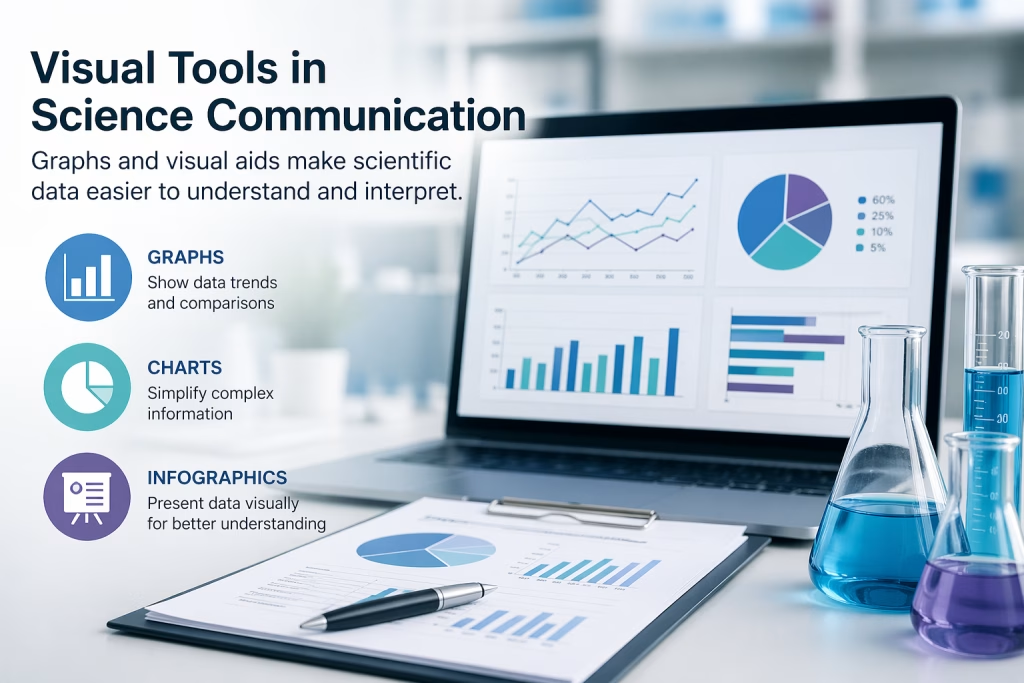
4. Improve Your Visual Communication
Visuals are a key part of effective science communication. They help simplify complex information and make research easier to understand at a glance.
Graphs, charts, and diagrams often communicate faster than words.
Good visuals should:
- Be clear and easy to interpret
- Support your message
- Avoid unnecessary complexity
Strong visuals make your research more engaging and accessible.
5. Practice Public Speaking and Presentation Skills
Speaking about your research is a core part of science communication. Whether in conferences or academic discussions, how you present your work affects how it is received.
Strong presentation skills build confidence and improve clarity.
You should focus on:
- Clear and confident delivery
- Structured presentation flow
- Engaging the audience
Good speaking skills increase the impact of your research.
6. Use Digital Platforms for Wider Reach
Modern science communication extends beyond academic journals. Digital platforms allow researchers to share knowledge with global audiences in real time.
These platforms help bridge the gap between science and society.
You can use:
- Blogs
- Social media
- Online videos
This expands the reach of your research far beyond traditional boundaries.
7. Build Consistency in Communication
Consistency is what turns communication into influence. In science communication, regularly sharing your work builds recognition, trust, and authority over time.
It is not about one big post, but continuous engagement.
You can improve consistency by:
- Publishing regularly
- Engaging with your audience
- Updating your research progress
Over time, this builds a strong academic presence and credibility.
Frequently Asked Questions
What is science communication?
Science communication is the process of sharing scientific ideas in a clear and accessible way for different audiences.
Why is science communication important?
It helps researchers share findings, influence decisions, and increase the impact of their work beyond academia.
How can I improve science communication?
You can improve through storytelling, simplifying ideas, using visuals, and engaging with your audience consistently.
Final Thoughts
Science communication is a critical skill for every researcher who wants to make a real impact. It transforms complex research into meaningful knowledge that can influence society and decision-making.
Strong science communication also plays a major role in career growth, helping researchers gain visibility, build networks, and access new opportunities.
If you are ready to grow as a researcher and improve your communication skills, structured mentorship can help you move faster and more effectively.
Comments are closed.