
Across Africa and many parts of the world, scientifically strong projects fail to secure financing, influence policy, or scale into transformative development programmes. The challenge is often not the science itself. The challenge of why your scientific project not funded is that evidence presented by science is rarely translated into the language of economics, investment, political priorities, and decision-making, lay man’s language to be precise.
In today’s development landscape, strong science is essential, but strategic communication is what transforms evidence into action.
Many scientists, researchers, and technical experts in various scientific disciplines spend years developing evidence-based solutions to some of the world’s most urgent challenges.
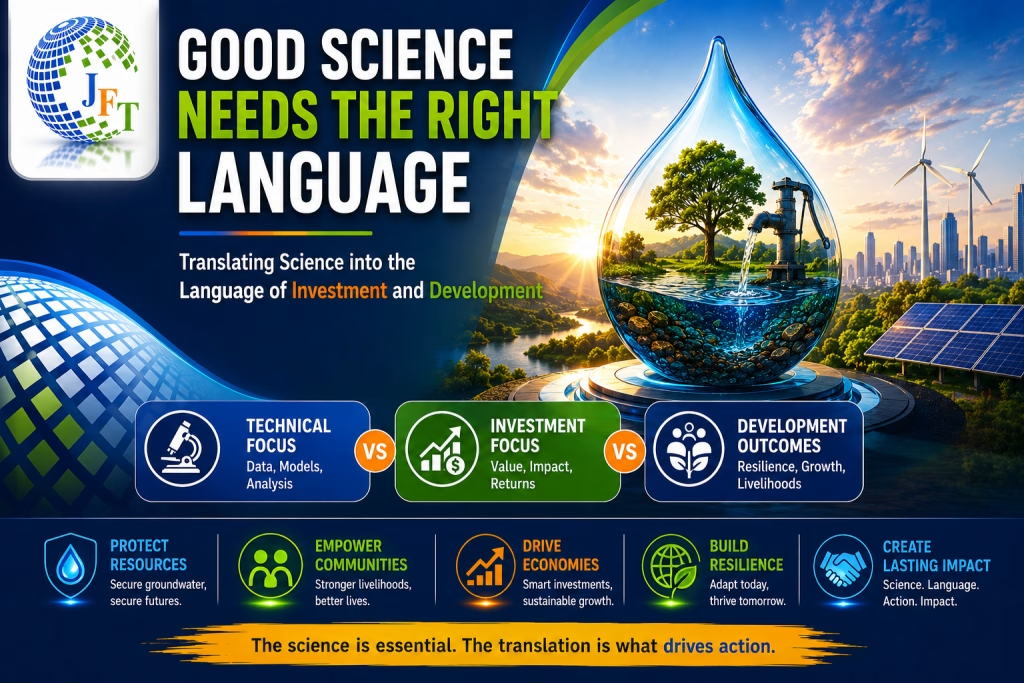
They generate data, build models, conduct assessments, validate findings, and design technically sound interventions. Yet despite this effort, many projects struggle to move beyond reports, workshops, pilot phases, and conference presentations. Some never receive meaningful investment. Others fail to influence policy. Many remain trapped in cycles of technical discussion while the very problems they seek to address continue to intensify.
Over time, one reality becomes increasingly clear: many scientifically strong projects fail not because the science is weak, but because the communication strategy is weak.
The Hidden Disconnect Between Science and Investment
Scientists are trained to value evidence, precision, technical rigor, and methodological excellence. Naturally, many assume that good science should speak for itself. But outside scientific circles, decisions are rarely shaped by technical evidence alone.
Government instututions, development banks, investors, and political leaders operate within systems influenced by economics, public priorities, political visibility, institutional mandates, fiscal realities, and implementation feasibility. This means that while scientists may focus on technical outputs, decision-makers are often focused on outcomes.
A hydrogeologist like Dr. Florence Tanui for example, may present groundwater recharge estimates, aquifer characterization results, or hydrochemical analyses. A climate scientist may showcase vulnerability assessments and rainfall projections. A conservation expert may demonstrate ecosystem degradation trends using sophisticated scientific methods. All of this work is critically important.
However, the audiences responsible for financing and policy decisions are often asking very different questions.
They want to know:
- What economic problem does this solve?
- How many livelihoods are protected?
- How does this support national priorities?
- Can this reduce future economic losses?
- Is the intervention scalable?
- Is implementation realistic?
- What measurable development value will be generated?
This disconnect between scientific communication and development decision-making is one of the biggest hidden barriers facing many projects today.
Why your Scientific Project Not Funded
One of the most painful realities in development is that technical excellence alone does not guarantee investment.
Across the world, there are thousands of scientifically sound projects sitting on shelves. Some contain years of research and extremely valuable insights. Others present innovative solutions to water insecurity, climate adaptation, environmental degradation, or food system resilience. Yet many fail to attract the support required for implementation at scale.
This often happens because projects are communicated primarily as technical exercises rather than development opportunities.
A proposal focused heavily on groundwater modelling, hydrological assessments, and monitoring systems may be scientifically exceptional. But if it fails to explain how these activities protect agricultural productivity, reduce drought-related losses, strengthen economic resilience, or support national development priorities, it may struggle to resonate politically and financially.
The science matters deeply. But the framing of the science often determines whether investment happens. This is why your scientifically strong project not funded
Translating Science into the Language of Investment
One of the most powerful transformations in development occurs when scientific evidence is translated into investment language.
This does not mean weakening science or oversimplifying technical realities. Instead, it means connecting scientific evidence to societal priorities, economic value, and development outcomes.
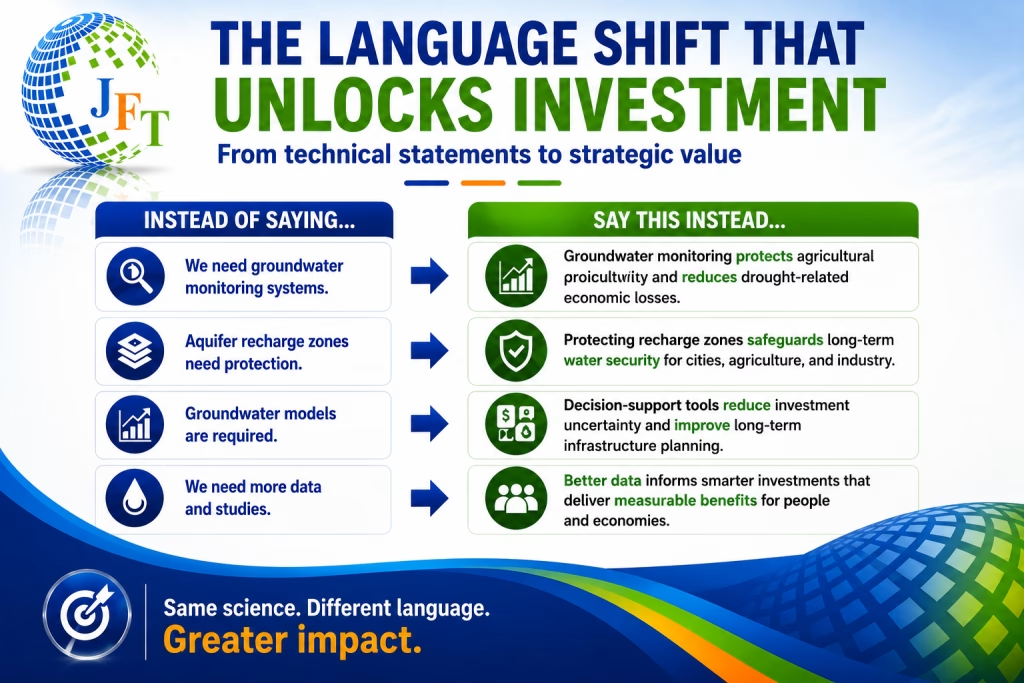
For example, many scientists might say:
“We need groundwater monitoring systems.”
Technically, this statement is correct.
But to many finance ministries or policymakers, it may sound like another technical expenditure.
Now consider this alternative:
“Groundwater monitoring protects agricultural productivity, reduces drought-related economic losses, and strengthens long-term water security for communities and industries.”
The science has not changed.
But the framing has completely changed the perceived value of the intervention.
Suddenly, the issue is connected to:
- economic resilience,
- food security,
- livelihoods,
- industrial stability,
- and climate adaptation.
This is the difference between communicating science and communicating strategic relevance.
Groundwater: A Powerful Example of Invisible Economic Value
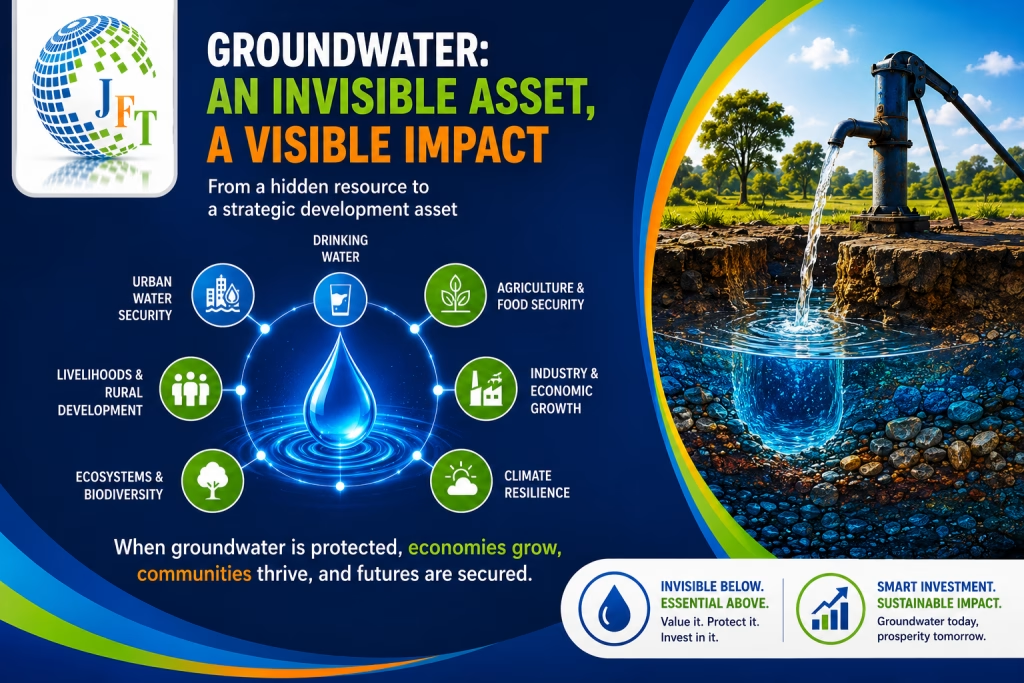
Groundwater provides one of the clearest examples of how critical scientific sectors remain economically invisible despite their enormous societal importance.
Across Africa, groundwater quietly sustains hundreds of millions of people through drinking water supply, agriculture, livestock systems, industry, ecosystems, and drought resilience. In many communities, groundwater becomes the difference between survival and crisis during prolonged dry periods.
Yet groundwater is still frequently treated as:
- a technical water issue,
- a hidden environmental resource,
- or a specialized hydrogeological concern.
Rarely is it framed as strategic economic infrastructure.
This communication gap has serious implications of why your scientific project not funded because governments prioritize what aligns with national development agendas. When groundwater is framed narrowly as a technical issue, it often struggles to compete against sectors perceived as more directly linked to economic growth or political priorities.
However, when groundwater is positioned as:
- drought resilience infrastructure,
- agricultural security,
- urban resilience,
- industrial support,
- climate adaptation,
- and economic stabilization,
the conversation changes dramatically.
Groundwater suddenly becomes visible not just as water, but as a strategic development asset.
Building a Business for Groundwater Projects and Investments
.A strong example of this shift is the ongoing work under the African Ministers’ Council on Water (AMCOW) Strategic Programme on Groundwater for Water Security and Resilience, particularly through Strategic Objective 3 (SO3), which focuses on building a business case for groundwater investment across Africa. The initiative recognizes that groundwater has historically remained undervalued despite underpinning agriculture, drought resilience, urban water supply, ecosystems, industry, and livelihoods for millions of people. Rather than framing groundwater solely as a technical or environmental issue, the initiative seeks to position it as a strategic economic and development asset capable of supporting climate resilience, food security, economic growth, and long-term stability. AMCOW is helping shift the continental conversation from groundwater as a hidden resource to groundwater as a driver of resilience, prosperity, and sustainable development, by promoting economic valuation studies, financing pathways, investment-ready groundwater programmes, and stronger integration into national development planning,.
The Difference Between Outputs and Outcomes
One of the most common communication mistakes in scientific and development projects is the tendency to focus heavily on outputs rather than outcomes.
Scientific reports often emphasize outputs such as:
- monitoring systems,
- vulnerability maps,
- hydrological models,
- technical assessments,
- databases,
- or policy reviews.
These outputs are important. But they are rarely what drives political attention or investment decisions. and possibly why your scientific project not funded.
Decision-makers are usually more interested in outcomes:
- reduced drought losses,
- improved food security,
- stronger urban resilience,
- protected livelihoods,
- reduced emergency response costs,
- increased economic productivity,
- or improved climate resilience.
This distinction fundamentally changes how projects are perceived.
For example:
A project framed around “hydrogeological mapping” may struggle to attract attention. But a project framed around “reducing investment uncertainty and protecting long-term water security for agriculture and cities” immediately becomes more compelling.
The technical work remains essential. But the communication now speaks directly to development priorities.
A Hypothetical Case: Two Climate Resilience Projects
Imagine two groundwater and climate resilience projects presented to a Ministry of Finance.
The first project focuses heavily on hydrogeological characterization, aquifer recharge modelling, groundwater assessments, and monitoring infrastructure. The science is rigorous and technically impressive. However, the proposal communicates primarily through technical language.
The second project contains similar scientific foundations but frames them differently. It explains how groundwater investments can reduce drought-related agricultural losses, strengthen rural economies, improve climate resilience, reduce emergency water supply costs, and protect long-term economic productivity in vulnerable regions. It also demonstrates implementation pathways, financing opportunities, measurable outcomes, and institutional partnerships.
Which project is more likely to receive political and financial support?
In many cases, it will be the second one.
Not because the science is necessarily stronger, but because the scientific evidence has been translated into development value.
Governments Invest in Priorities, Not Just Problems
Governments rarely invest heavily in something simply because it is scientifically important.
They invest when issues connect directly to:
- economic growth,
- political priorities,
- employment,
- public health,
- infrastructure,
- food security,
- climate resilience,
- and fiscal stability.
This is why groundwater projects gain stronger traction when linked to irrigation expansion, drought preparedness, urban resilience, agricultural productivity, or industrial development.
The same principle applies across many scientific sectors. Climate adaptation programmes become more compelling when framed around avoided economic losses and long-term resilience. Ecosystem restoration projects gain momentum when linked to water security, livelihoods, tourism, or disaster risk reduction.
In many cases, the success of a project depends not only on scientific quality, but on whether stakeholders can clearly see its strategic value.
What Makes a Project Bankable?
How do you avoid why your scientific project not funded? The development world increasingly emphasizes “bankable projects,” especially in climate finance, resilience investment, and sustainable development programming.
However, many technical experts misunderstand what bankability actually means.
A bankable project is not simply a project with strong science. It is a project that combines scientific credibility with:
- economic relevance,
- implementation readiness,
- institutional support,
- financing pathways,
- measurable impact,
- scalability,
- and strategic communication.
Successful projects usually share common characteristics. They define a clear societal challenge, demonstrate economic and development value, show how risks can be reduced, and explain why the intervention matters beyond technical sectors alone.
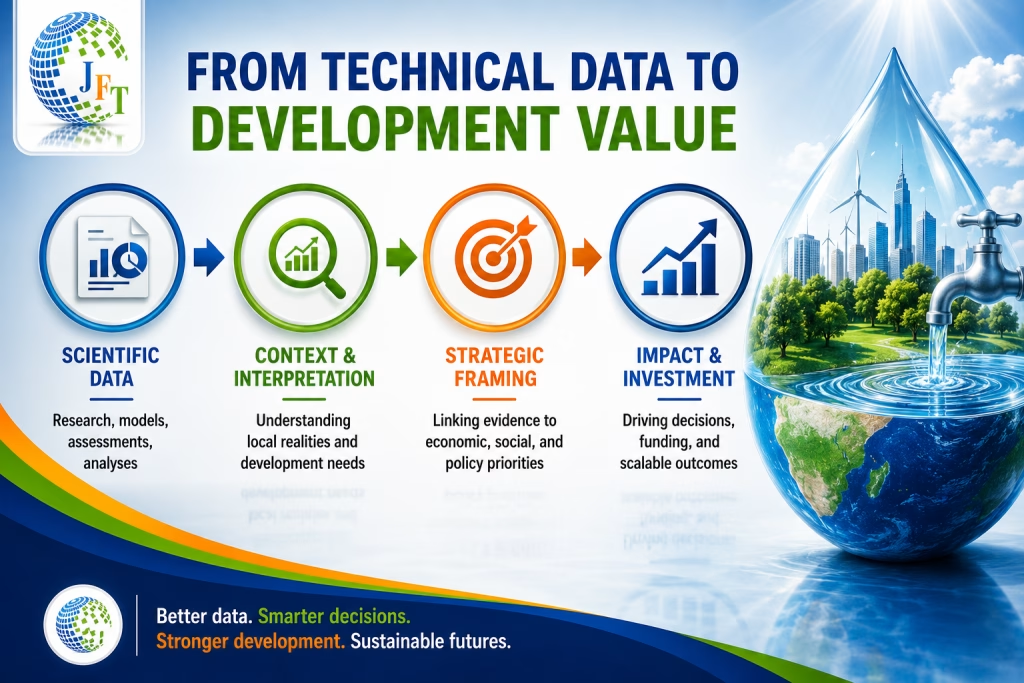
Importantly, they also provide confidence that implementation is feasible.
Financiers and governments need to see:
- institutional coordination,
- implementation capacity,
- policy alignment,
- partnerships,
- sustainability pathways,
- and measurable results.
Science may provide the foundation, but confidence drives investment.
Science Communication Is Becoming a Leadership Skill
Many people still think of science communication as the ability to simplify technical information for public audiences. But in reality, science communication is increasingly becoming a strategic leadership skill. It contributes to over 70% of why your scientific project not funded.
Strong scientific leaders today must be able to move between different worlds:
- science and policy,
- evidence and investment,
- technical expertise and political realities,
- research and implementation.
This requires understanding how different audiences think and make decisions.
A scientist may prioritize methodological rigor and uncertainty analysis. A minister may prioritize political visibility and economic outcomes. A financier may focus on risk reduction, scalability, and return on investment. Communities may focus on livelihoods, water access, and immediate survival needs.
Strong communicators understand all of these dimensions simultaneously.
They do not weaken science. They strengthen its ability to influence society.
Why This Matters for Africa’s Future: Translating Science into the Language of Investment
Africa is entering a period where climate pressures, rapid urbanization, food insecurity, water stress, and financing challenges are increasingly interconnected. The continent urgently needs scientifically grounded solutions. But it also needs stronger science-policy-investment translation.
Many of Africa’s most important development opportunities already exist:
- groundwater resources,
- renewable energy potential,
- ecosystem restoration opportunities,
- climate adaptation solutions,
- and innovative scientific expertise.
The challenge is often not the absence of solutions.
The challenge is the inability to communicate these solutions in ways that unlock political support, institutional ownership, and investment.
This is why future scientific leadership will increasingly depend not only on technical expertise, but also on the ability to frame evidence strategically, mobilize partnerships, influence decisions, and translate science into societal transformation.
Final Reflection: Science Alone Is Not Enough
Scientifically strong projects do not automatically become funded projects.
Technical excellence alone does not guarantee implementation, political support, or investment and this may be linked to why your scientific project not funded.
Projects become transformative when scientific evidence is translated into:
economic relevance, societal value, strategic importance, and measurable development outcomes.
The future belongs not only to scientists who generate knowledge, but to those who can transform knowledge into decisions, partnerships, financing, and large-scale impact.
Because ultimately, the projects that shape the future are not always the ones with the most data.
They are often the ones that successfully connect science to people, priorities, and possibility.