
For years, students, graduates and early-career scientists have reached out to me with the same questions. How do I get my first job when my CV only shows coursework? How do I explain my research to people who are not scientists? How do I lead when I have no title? I have answered many of these in conversations, at workshops and over email — but one person can only have so many conversations in a week. Self-guided mentorship is how I can reach many more of you.
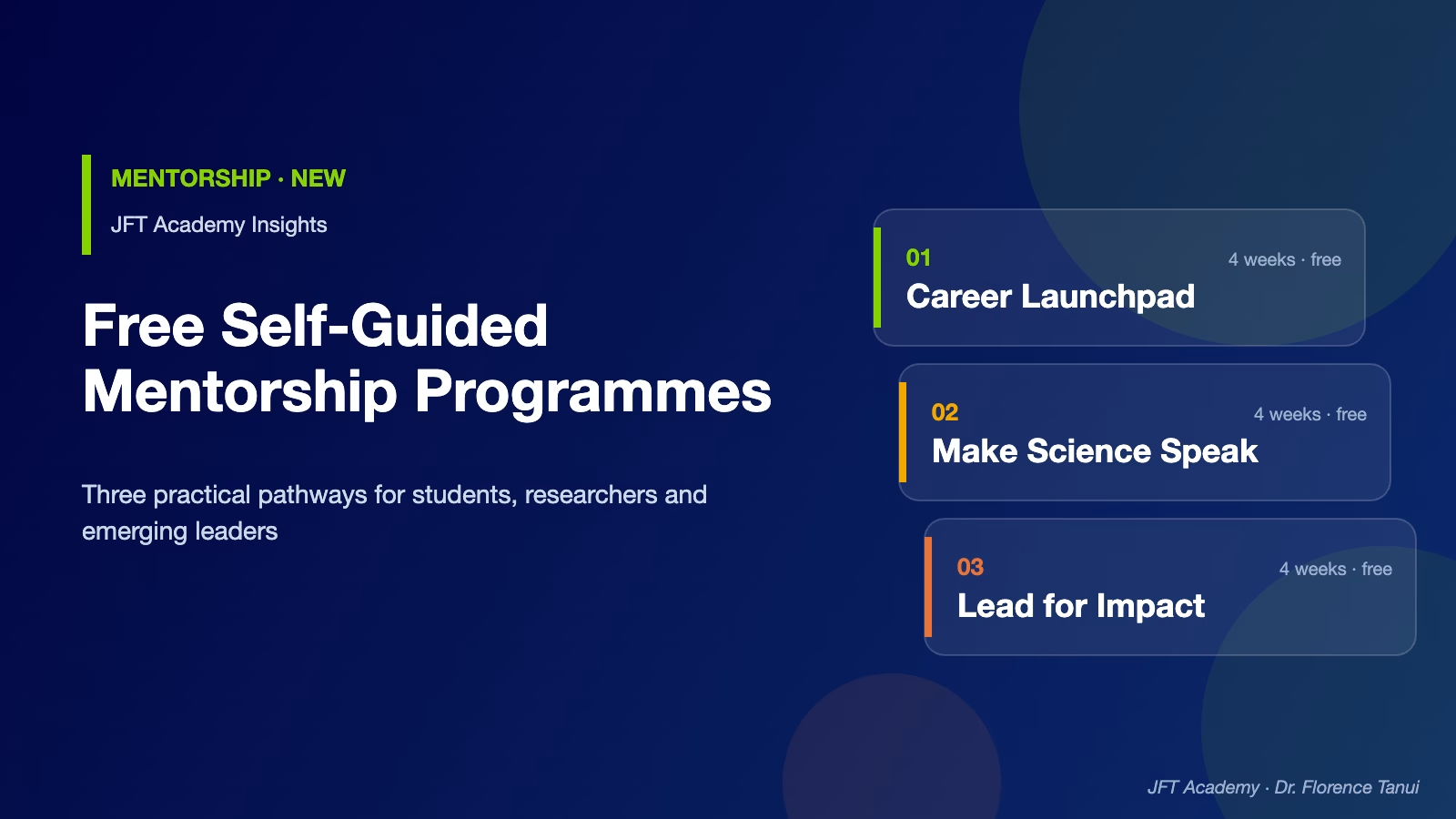
So I have taken the core of that guidance and turned it into something you can use on your own schedule. Today I am launching the JFT Self-Guided Mentorship Programmes: three free, practical, four-week programmes on JFT Academy, each built around one of the three JFT mentorship pathways.
Why self-guided mentorship, and why now?
Good mentorship changes careers. It helps people see what they cannot see on their own, avoid common mistakes and move with more confidence. But traditional one-to-one mentorship has limits. Experienced mentors are busy, waiting lists grow, and many talented people — especially young women in geoscience and those outside major cities — never get matched with anyone at all.
Self-guided mentorship does not replace human relationships. It makes the most useful parts of mentorship available to everyone: clear frameworks, practical exercises, real examples and a structured path forward. You can start tonight, work at your own pace, and come back to the material whenever you need it.
The programmes are designed for people who are busy, ambitious and often doing several things at once. Each week takes about two to three hours. Lessons are short, visual and practical, with a dash of humour — because learning does not have to be dull to be serious.
The three self-guided mentorship programmes at a glance
1. Career Launchpad: from graduate to trusted professional
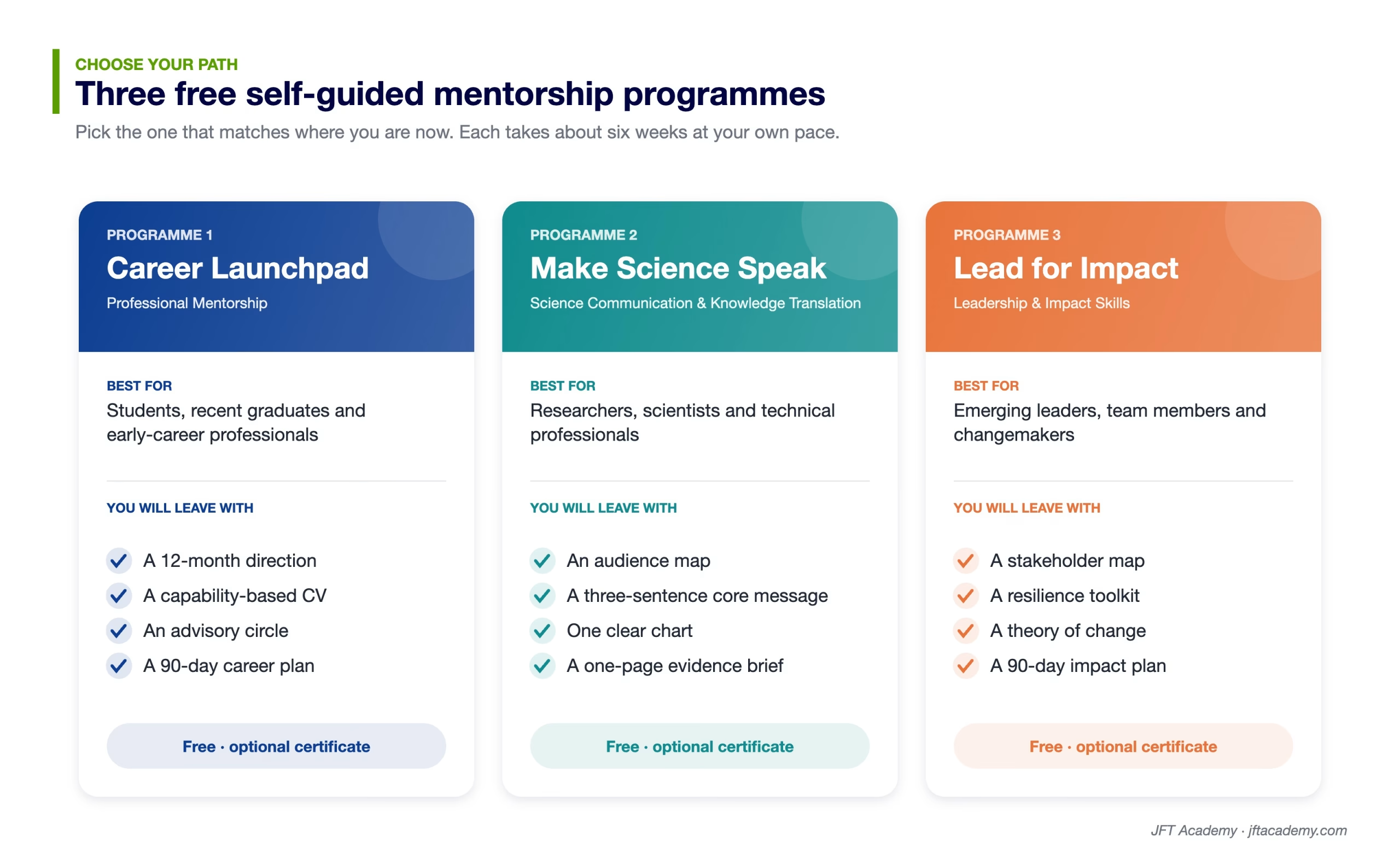
Career Launchpad is for anyone who has the degree but feels stuck at the starting line. Over four weeks you will complete an honest self-audit across four areas — knowledge and skills, experience, visibility and network, and confidence and voice — and turn it into a realistic 12-month direction.
You will then learn the capability formula for rewriting your CV so that it shows what you can do, not just what you studied. You will build visibility without “self-promotion”, form a personal advisory circle instead of searching for one perfect mentor, prepare interview stories using the STAR method, and finish with a one-page 90-day career plan.
2. Make Science Speak: communicating research that drives action
Brilliant research that nobody understands is like a borehole without a pump: the water is there, but nobody can drink it. Make Science Speak helps scientists and technical professionals make their work understood, remembered and used.
You will learn to beat the “curse of knowledge”, write a three-sentence core message, use storytelling without bending the evidence, turn numbers into meaning, design charts with a clear message, present with confidence and translate research into one-page evidence briefs and funder-ready language. Every exercise uses one piece of your own work, so by the end it can speak to anyone.
3. Lead for Impact: leadership, decisions and resilience for changemakers
You do not need a corner office to lead. Lead for Impact covers everyday leadership behaviours, leading when you are the only one like you in the room, systems thinking, better decisions under uncertainty, managing priorities, influencing without authority, giving useful feedback and building resilience. It closes with a simple theory of change and a 90-day impact plan built around a real challenge you care about.
How self-guided mentorship works at JFT Academy
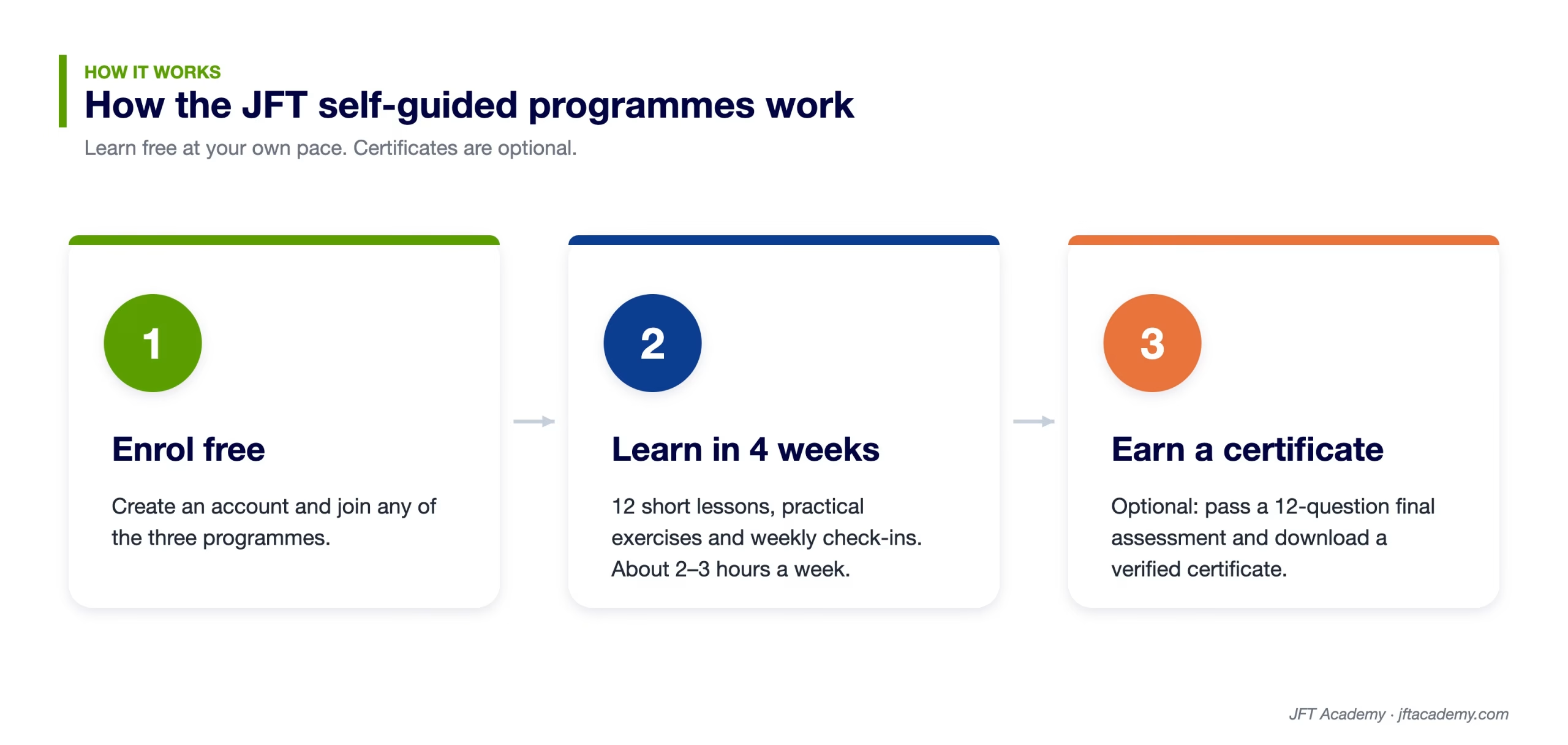
- Enrol free. Create a free JFT Academy account and join any programme. There is no payment to learn.
- Learn at your own pace. Each programme has four weekly modules with three short lessons each, a practical exercise and a quick check-in quiz. Lessons unlock in order so you build skills step by step.
- Keep a growth journal. Every exercise goes into one notebook or document. By the end it becomes your personal development record.
- Earn a certificate (optional). If you want formal recognition, take the Certificate Assessment for that programme.
Tip: Find an accountability partner — a classmate, colleague or someone from the JFT mentorship forum — and work through the same programme together. Learners who check in with someone every week are far more likely to finish.
About the optional certificates
Learning is completely free. If you would like a verified certificate for your CV or LinkedIn profile, each programme offers an optional Certificate Assessment. It includes a 12-question final assessment based on all four weeks (pass mark 75%, up to three attempts) and a downloadable JFT Academy certificate signed by me. Full details are shared with mentees inside each programme.
The certificate is there for those who want it. The real value is in the work you do along the way — the CV you rewrite, the message you sharpen, the plan you act on.
What makes this self-guided mentorship different?
- Grounded in real experience. The lessons draw on my own path from rural Kenya through the University of Nairobi and Cardiff University into groundwater, climate resilience and science–policy work — including the detours and setbacks.
- Built for African and climate-vulnerable contexts. Examples come from boreholes, county planning, drought and water security, not only from textbook case studies.
- Practical, not theoretical. Every lesson ends with something to do. Reading about push-ups does not build muscles.
- Visual and engaging. Each programme includes custom diagrams, before-and-after examples and “real talk” moments that keep things human.
Who should start where?
If you are a student or recent graduate, start with Career Launchpad. If you are a researcher or practitioner whose work is not getting the attention it deserves, start with Make Science Speak. If you are already working and want to grow your influence and impact, start with Lead for Impact. Many people will benefit from all three — in any order.
Getting the most from self-guided mentorship
Self-guided mentorship works best when you treat it like a commitment rather than a casual read. These habits make the biggest difference:
- Schedule it. Block two or three hours a week in your calendar, as you would for a class or meeting.
- Do the exercises in writing. Your growth journal turns reading into action and becomes a record of your progress.
- Apply one idea immediately. Rewrite a CV line, test a three-sentence message on a friend, or practise one leadership habit at work the same week.
- Share your progress. Tell an accountability partner what you will do before the next check-in.
- Come back to it. The materials stay available, so revisit lessons when you face a new interview, presentation or leadership challenge.
Self-guided mentorship does not mean doing it alone. It means having a clear path, practical tools and a community to grow with — at a pace that fits your life.
Further reading: the National Academies’ consensus report The Science of Effective Mentorship in STEMM summarises the evidence on what makes mentoring relationships work, and it shaped the structure of these self-guided mentorship programmes.
Frequently asked questions
Are the programmes really free?
Yes. All lessons, exercises and weekly check-ins are free. The certificate is optional, and mentees find the details inside each programme.
How long does each programme take?
About four weeks at two to three hours per week. Because it is self-paced, you can go faster or slower.
Do I need a science background?
Career Launchpad and Lead for Impact are useful for anyone early in their career. Make Science Speak is designed for people who work with research, data or technical information.
Is there live mentoring?
The programmes are designed to be completed independently. You can connect with other mentees in the forum and follow new articles on the JFT Academy blog.
Start today
Growth is stronger when it is guided — and it no longer has to wait for a free slot in someone’s calendar. Explore all three pathways on the Self-Guided Mentorship Programmes page, choose the one that fits where you are right now, and take the first step this week.
I look forward to seeing what you build.