

Clear water is not always safe water. Borehole water can look, smell and taste perfectly fine and still contain harmful bacteria, excess fluoride or nitrate. Equally, water that looks rusty or tastes salty may be safe to drink but damaging to pipes and appliances. The only way to know is to test.
Groundwater quality has been at the centre of my research, including my doctoral work on the hydrogeochemistry of the Lodwar alluvial aquifer in Turkana. In this guide I explain which tests matter most for borehole owners in Kenya, how often to test, how to take a good sample and how to read your laboratory report.
In short: test new boreholes before use for a full set of microbiological and chemical parameters; test for bacteria at least once a year and after floods, repairs or any change in taste, smell or colour; use an accredited laboratory; and compare results with Kenya’s potable water standard (KS EAS 12) and the World Health Organization guidelines.
Why borehole water quality varies
Groundwater picks up its chemistry from the rocks and sediments it moves through, and from what happens on the land above. That means quality depends on both natural geology and human activity:
- Natural sources: volcanic rocks in the Rift Valley can release fluoride; some formations add iron, manganese or, rarely, arsenic; coastal and arid aquifers can be salty.
- Human sources: pit latrines and septic tanks, livestock, fertilisers, fuel stations, waste dumps and poorly sealed boreholes can introduce bacteria, nitrate and other contaminants.
- Borehole construction: a cracked apron, missing sanitary seal or poorly fitted cover lets surface water run straight into the borehole.
The borehole water tests that matter most
1. Microbiological tests: E. coli and faecal coliforms
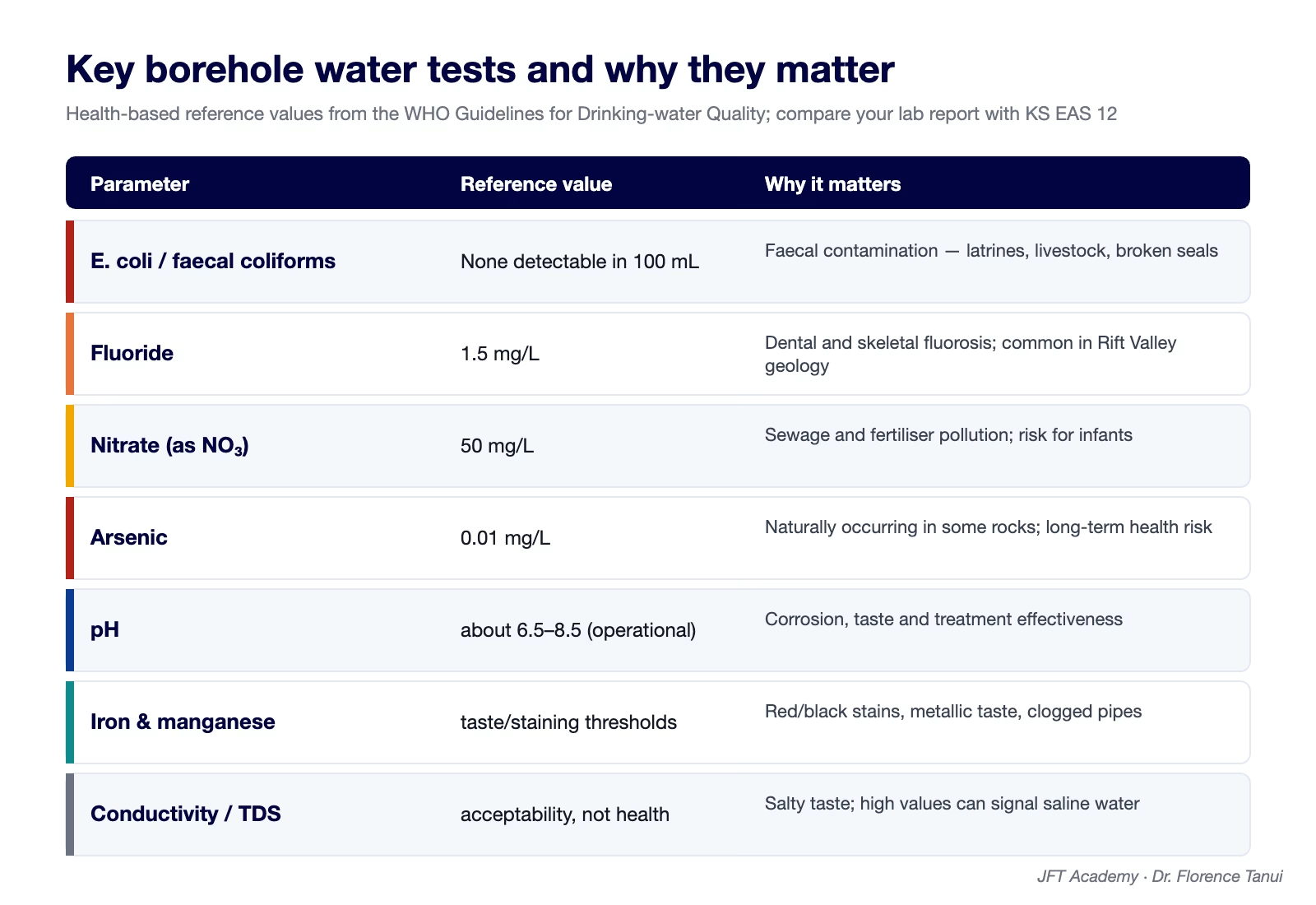
These are the most important tests for drinking water. E. coli and faecal coliforms indicate contamination from human or animal waste, which can carry diseases such as cholera, typhoid and diarrhoeal infections. For drinking water, none should be detectable in a 100 mL sample. Any positive result means the water should be treated before drinking and the source of contamination investigated.
2. Fluoride
Fluoride is one of the most significant natural water quality problems in Kenya, particularly in parts of the Rift Valley. Small amounts help protect teeth, but long-term exposure to high concentrations causes dental fluorosis (brown, mottled teeth) and, at higher levels, skeletal fluorosis. The WHO guideline value is 1.5 mg/L. If your borehole exceeds this, seek advice on defluoridation or alternative drinking water sources, especially for children.
3. Nitrate
Nitrate usually comes from sewage, latrines or fertilisers, so elevated levels are a warning sign that pollution is reaching the aquifer. The WHO guideline value is 50 mg/L as nitrate. High nitrate is particularly risky for bottle-fed infants.
4. Arsenic and other metals
Arsenic is uncommon in most Kenyan aquifers but is worth including in the first full analysis of a new borehole, especially in volcanic or mineralised areas. The WHO guideline value is 0.01 mg/L (10 µg/L). Depending on location, your laboratory may also recommend tests for lead, manganese or other metals.
5. pH, iron, manganese and salinity
These are mainly about acceptability and the health of your system. Very acidic or alkaline water can corrode pipes or reduce the effectiveness of chlorination. Iron and manganese cause red or black staining, metallic taste and clogged pipes. High electrical conductivity or total dissolved solids (TDS) indicates salty water, which may be unpleasant to drink and harmful to crops, soils and appliances.
6. Turbidity, colour and odour
Cloudy or muddy water — common after heavy rain — can shield bacteria from disinfection and may signal that surface water is entering the borehole. A rotten-egg smell usually indicates hydrogen sulphide.
How often should you test?
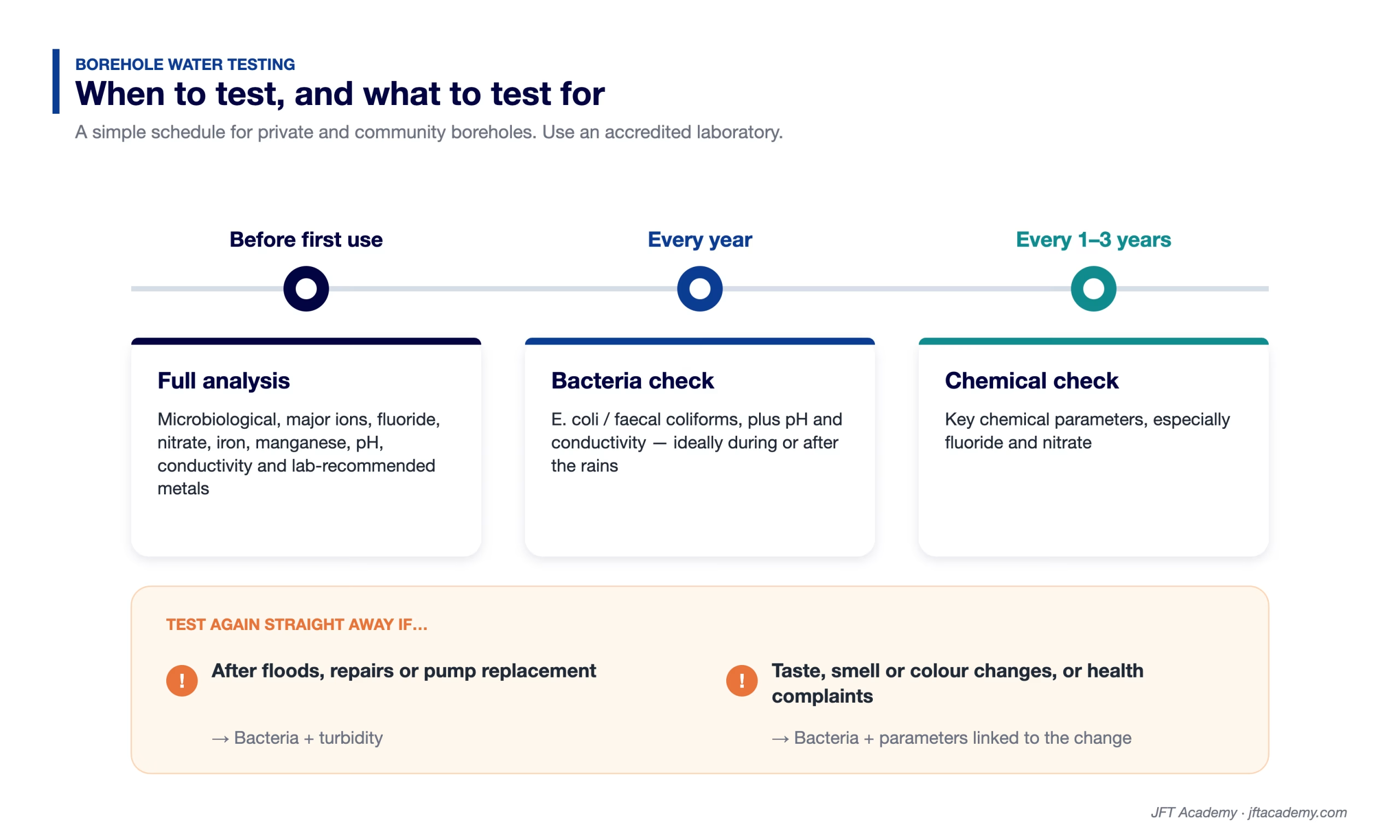
Season matters: bacterial contamination is often worst during and after heavy rains, when runoff carries waste into poorly protected wells and boreholes. If you test only once a year, consider doing it during or just after the rainy season.
How to take a good borehole water sample
- Contact the laboratory first. Ask which bottles and preservation they require — microbiological samples need sterile bottles.
- Sample from a tap close to the borehole, before any storage tank or filter, unless you want to test the water after treatment.
- Flush the tap for a few minutes so you collect fresh groundwater, not water that has been sitting in pipes.
- Do not touch the inside of the bottle or cap, and do not rinse sterile bottles.
- Label clearly with location, date and time.
- Keep samples cool and deliver them quickly — microbiological samples should usually reach the lab within 24 hours.
Choosing a laboratory and understanding costs
Use a laboratory that is accredited for water analysis — for example government water testing laboratories or private laboratories accredited by the Kenya Accreditation Service (KENAS). Ask which standard they will report against and whether the price covers both microbiological and chemical tests.
Costs depend on how many parameters you test. Recent Kenyan cost guides put a water quality analysis for a borehole at around KSh 15,000–30,000, while basic packages with fewer parameters can cost less. A comprehensive first analysis is worth the investment; routine annual checks can focus on fewer parameters.
Reading your laboratory report
A typical report lists each parameter, your result, the unit, the standard limit and sometimes a pass/fail comment. When reading it:
- Check the units. mg/L and µg/L differ by a factor of 1,000.
- Look at microbiological results first. Any E. coli means the water is not safe to drink without treatment.
- Compare health-related parameters such as fluoride, nitrate and arsenic with the limits.
- Note aesthetic parameters such as iron, manganese and TDS — these affect taste, staining and equipment.
- Keep every report. Comparing results over time reveals trends, such as slowly rising nitrate, before they become serious.
What to do if your borehole water fails a test
- Bacteria present: treat drinking water (boiling, chlorination or an appropriate filter), inspect and repair the borehole seal, apron and cover, check for nearby pollution sources, disinfect the borehole if advised, and re-test.
- High fluoride: use an alternative source for drinking and cooking, or install a defluoridation system recommended by a qualified professional.
- High nitrate: identify and address pollution sources and use alternative drinking water for infants.
- Iron, manganese or salinity: consider appropriate treatment (for example aeration and filtration for iron) or use the water for non-drinking purposes.
Treatment should always be matched to the specific problem. A filter that removes bacteria will not necessarily remove fluoride or salt.
Prevention is better than treatment
- Site boreholes well away from latrines, septic tanks, livestock pens and waste — sanitation guidance commonly recommends at least 30 metres, more in permeable ground.
- Make sure the borehole has a sanitary seal, a raised concrete apron that drains water away, and a secure cover.
- Keep the area around the borehole clean and fenced.
- Do not store fuel, chemicals or fertiliser near the borehole.
- Service pumps and inspect headworks regularly.
For more on choosing a site and building a borehole properly, see my guide to drilling a borehole in Kenya.
A simple borehole water safety routine
Good borehole water management is mostly about routine. Build these habits into your year:
- Keep a logbook with test dates, results, repairs and any changes you notice in the borehole water.
- Inspect the headworks every month for cracks, standing water or a loose cover.
- Test borehole water for bacteria every year, ideally during or just after the rains.
- Repeat chemical tests such as fluoride and nitrate every one to three years, or sooner if land use nearby changes.
- Act quickly on any change in taste, smell, colour or health complaints.
With a simple routine and good records, you will spot problems early and keep your borehole water safe for everyone who depends on it.
Frequently asked questions
Can I tell if water is safe by looking at it?
No. Many harmful contaminants, including bacteria, fluoride and nitrate, are invisible and tasteless at dangerous levels.
Does boiling make borehole water safe?
Boiling kills bacteria and other pathogens, but it does not remove chemicals such as fluoride, nitrate or arsenic — and it can concentrate them slightly.
Which standard applies in Kenya?
Drinking water is assessed against Kenya’s potable water specification (KS EAS 12, the East African standard adopted in Kenya). Your laboratory will state which standard it reports against.
Final word
Testing your borehole water is one of the simplest and most important things you can do to protect your family, staff or community. Test when the borehole is new, test regularly, keep your records and act quickly on any warning signs. Safe water is not just about having water — it is about knowing it is safe.
This article provides general information and is not a substitute for advice from a qualified water quality professional or public health authority. Always follow your laboratory’s guidance and the applicable Kenyan standards.