

The urban groundwater management including small and big cities is not just an issue for Africa. This is a cross-cutting issues in all the seven continents due to rapidly urbanising regions and is no doubt water is behind every developing economy. The challenges in Africa are louder and more visible than the rest of the planet because of the concerns around sustainability of water resources development in general that is weak in the region. Africa presents weaker water governance systems and infrastructure gaps, the underlying drivers of aquifer failure are remarkably similar worldwide.
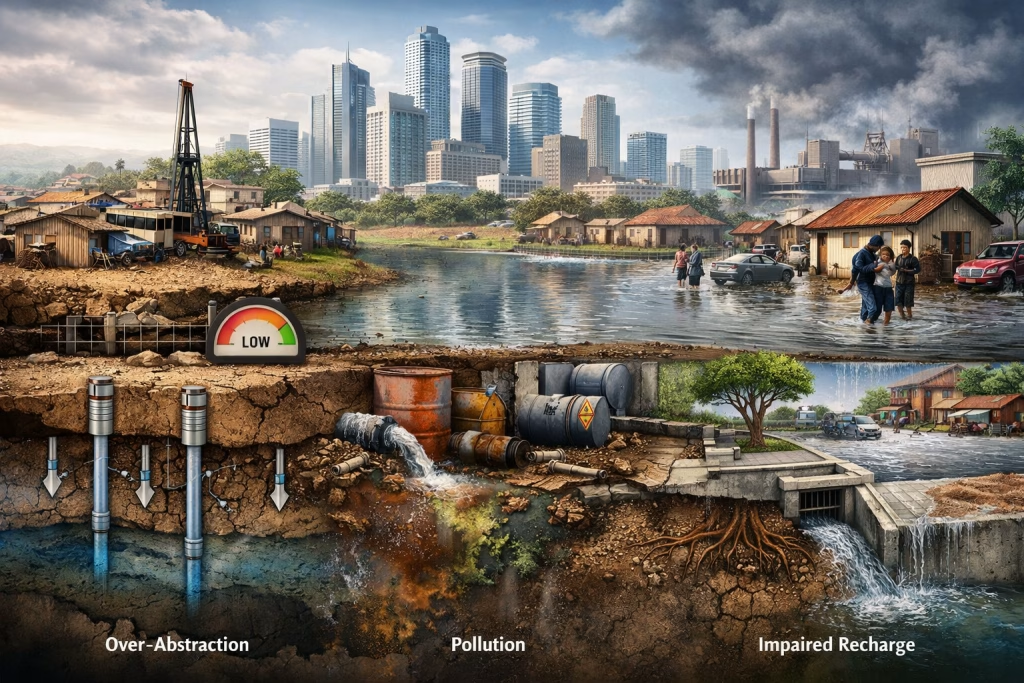
However, many cities beyond Africa have receorded decades of groundwater development failures that have mopre pronounced failures than those receorded in Africa. Across Asia, cities such as Bangkok, Jakarta, and Delhi have experienced severe land subsidence due to excessive groundwater extraction. In Jakarta, for example, parts of the city are sinking by more than 10 cm per year, largely driven by uncontrolled pumping from shallow aquifers.
Similarly, Mexico City—built on a former lakebed—has faced long-term aquifer depletion and subsidence, causing infrastructure damage and increasing flood risk in the region.
In Europe and North America, where regulatory systems are more established, the challenges are less about access and more about legacy pollution and overuse. Cities like London and New York have had to invest heavily in restoring and managing aquifers previously degraded by industrial contamination. Even in these contexts, failures in urban groundwater management have required decades of policy reform, monitoring, and financial investment to reverse.
It is important to mention at this point that groundwater failures are more expensive to reverse and sometimes an impossible mission. It is best if preventive management is given more attention both by the water user, water managers and policy makers.
The Problem Cities Don’t Want To See: Evolving Urban Groundwater Management Concerns
As cities grow faster than water infrastructure, households, institutions, and industries increasingly turn to boreholes. This creates a parallel water system beneath the city: largely unregulated, unevenly monitored, and deeply vulnerable. Urban groundwater management is now a core urban survival issue.
Water supply companies still plan as if groundwater is “backup water.” In reality, in many cities groundwater is primary water—especially for informal settlements, small businesses, hospitals, and residerntial estates and private home owners. In many African cities, the crisis is amplified by limited planning capacity, fragmented institutional mandates, and insufficient investment in water infrastructure.
In cities like Nairobi, Lagos, and Dar es Salaam, entire neighbourhoods depend almost entirely on boreholes. This often results in unregulated abstraction, poor monitoring, and widespread contamination risks. However, it would be misleading to view this as a uniquely African problem. In reality, urban groundwater management failures have been unfolding globally for decades—often silently—beneath some of the world’s most advanced cities.
1. Over-Abstraction And Declining Water Levels
The complexity of the issue lies in the fact that urban groundwater is exposed to a unique combination of risks that are often poorly understood and rarely managed in an integrated way. One of the most critical challenges is over-abstraction and declining water levels. When thousands of boreholes draw from the same aquifer without coordinated regulation, groundwater levels steadily decline. This has already become a concern in parts of Nairobi, particularly in areas such as Karen and Lang’ata, where increasing borehole density has raised alarm among regulators.
Recent rulings and actions involving the Water Resources Authority (WRA) and the Environment and Land Court have highlighted the risks of uncontrolled abstraction in these zones. As water levels drop, shallow wells—often used by lower-income households—are the first to fail, deepening inequality in access to water.

My reflection to this ruling: Without water in the taps provided through the Water Water and sewerage company, each home owner will continue to drill the boreholes. It’s not a choice—it’s a necessity. But this raises a difficult question that we don’t often want to confront. If you already have a borehole, are you willing to share that water with your neighbour? In most cases, the answer is no. And that neighbour is simply doing what you once did—drilling their own borehole to secure water for their household. Sometimes the lack of your in your borehole doesn’t mean it is dry, the water table inside your well may be below the cone of depression most of the time. The response to limited water supply in the case of groundwater is not the number of wells, it is how efficient we use one well.
2. Pollution From Sanitation And Solid Waste Systems
A second major risk is pollution from inadequate sanitation and waste management systems. In cities where sewer coverage is limited, groundwater is highly vulnerable to contamination from septic tanks, pit latrines, and poorly managed wastewater systems. This is a widespread issue in rapidly growing urban centres across Africa and South Asia. In addition, industrial activities, fuel stations, and unregulated dumping sites introduce chemical pollutants that can persist in aquifers for decades.
As one often overlooked reality is that “Africa is still relatively lucky—most of our urban groundwater contamination is biological, not yet dominated by complex chemical pollution seen elsewhere.”
However, this window of opportunity is closing. Emerging cases, such as hydrocarbon contamination linked to leaking fuel stations in parts of Nairobi and industrial pollution hotspots in cities like Lagos and Addis Ababa, signal a shift toward more persistent and difficult-to-treat pollutants. In other parts of the world, including cities like Delhi and regions in China, groundwater contamination by heavy metals and industrial chemicals has rendered entire aquifers unsafe for use.
Once contaminated, groundwater systems are extremely difficult and costly to restore—making prevention the only viable long-term strategy.
3. Land-Use Change That Destroys Recharge
The third challenge is land-use change that disrupts natural recharge processes. Urbanisation replaces permeable surfaces with concrete, asphalt, and buildings, significantly reducing the ability of rainwater to infiltrate into the ground. What is often overlooked is how everyday urban design choices—such as large paved parking areas, shopping complexes, and residential driveways—contribute to this problem.
Many parking spaces in cities are designed for durability and drainage efficiency, using impermeable materials and rapid runoff systems that channel water away almost instantly. While this may reduce localised ponding, it prevents water from soaking into the soil and recharging aquifers. In effect, cities are engineered to shed water rather than retain it. Over time, this not only reduces groundwater recharge but also increases surface runoff, placing additional pressure on drainage systems and raising the risk of urban flooding.
This design challenge is rarely addressed in urban groundwater management, where the focus tends to remain on abstraction rather than recharge. Yet, simple interventions—such as permeable pavements, infiltration trenches, green parking designs, and protected recharge zones—can significantly restore the balance between built infrastructure and natural hydrological processes. Without integrating such approaches into urban planning, cities unintentionally cut off their own groundwater supply while simultaneously increasing flood vulnerability.
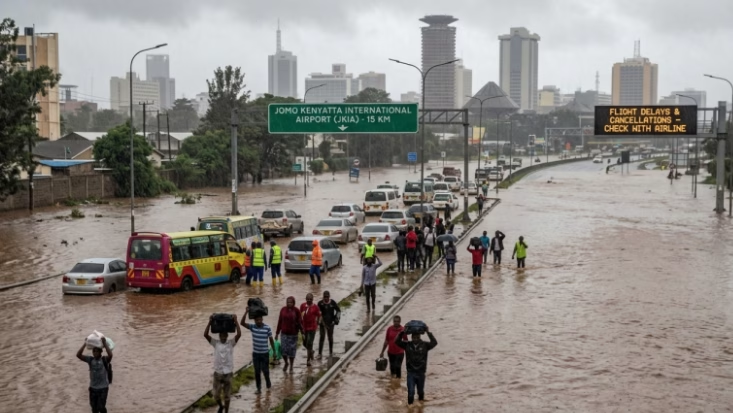
The Nairobi Floods 2026
The consequences of this disconnect were clearly visible during the Nairobi floods of March 2026. Intense rainfall events overwhelmed urban drainage systems, leading to widespread flooding across multiple parts of the city, including informal settlements and rapidly developing peri-urban areas. Roads were submerged, homes were inundated, and critical infrastructure was disrupted. While such events are often attributed solely to extreme weather, they also reflect deeper structural issues in how the city manages land, water, and growth. Large expanses of paved surfaces, blocked drainage channels, and encroachment into natural waterways accelerated runoff and reduced the land’s capacity to absorb water. At the same time, limited groundwater recharge during such events represents a missed opportunity—where excess water becomes a hazard rather than a resource. This illustrates a growing paradox in many cities: flooding on the surface and depletion underground, occurring at the same time.
4. Institutional Fragmentation
Finally, institutional fragmentation remains one of the most persistent and underestimated barriers to effective action. In many cities, responsibility for groundwater is divided among multiple agencies—water resources authorities, water and sewerage companies, environmental regulators, county governments, and urban planning departments—each operating with partial mandates and limited coordination. While each institution plays a critical role, the lack of integration creates systemic gaps that are difficult to close.
This raises fundamental questions that often go unanswered in practice: who regulates borehole drilling and abstraction in rapidly growing neighbourhoods? Who is responsible for monitoring groundwater quality in informal settlements? Who protects recharge zones from being converted into housing estates, roads, or parking areas? And critically—who ensures that urban design decisions, such as drainage systems and land paving, support rather than undermine groundwater sustainability?
In cities like Nairobi, these responsibilities are spread across institutions such as the Water Resources Authority (WRA), county governments, water service providers, and environmental agencies. However, coordination between these actors is often reactive rather than strategic. For example, decisions on land use and urban development are frequently made without fully considering their long-term impacts on groundwater recharge or flood risk. Similarly, enforcement of borehole regulations may not keep pace with the speed of urban expansion.
The result is a system where everyone is responsible—but no single institution is fully accountable. This leads to weak enforcement, fragmented data systems, and delayed responses to emerging risks such as over-abstraction, contamination, and urban flooding. Without clear institutional alignment and shared accountability frameworks, even well-designed policies fail at the point of implementation.
This is why urban groundwater management cannot sit within a single agency. It must be treated as a cross-cutting urban governance issue—requiring coordination between water, land-use planning, sanitation, and environmental systems. Without this integration, cities will continue to manage symptoms rather than address the root causes of aquifer decline.

I am an expert at the science–policy interface on groundwater governance, water security, and climate resilience, with a focus on African and climate-vulnerable contexts. My work involves applied hydrogeological analysis, risk assessment, decision support, and institutional strengthening, including engagement in transboundary groundwater dialogue and regional cooperation processes. I contribute to programme design, policy dialogue, and capacity development, translating groundwater data and systems understanding into actionable guidance for governments, development partners, and implementing agencies.