
March 22 marks the World Water Day each and the World Water Day 2026 marked a significant shift in global water discourse—from awareness to accountability. During this day several agencies, and institutions reflects on the various milestones and future roadmaps for water security and management. It is difficult to track global conversations but this year’s messaging went beyond highlighting challenges and instead emphasised implementation, resilience, and equity.
Across United Nations agencies, governments, development partners, academia, and social platforms, World Water Day 2026 delivered a clear signal: water is no longer a sectoral issue—it is the foundation of climate resilience, economic stability, and human survival.
JFT Academy led by Dr. Florence Tanui has synthesized the most prominent messages shaping global water narratives and what they mean for policy, investment, and action. To capture the various messages across sectors and themes relevant to water security and resources development, we have organised the key messages in nine (9) key areas.
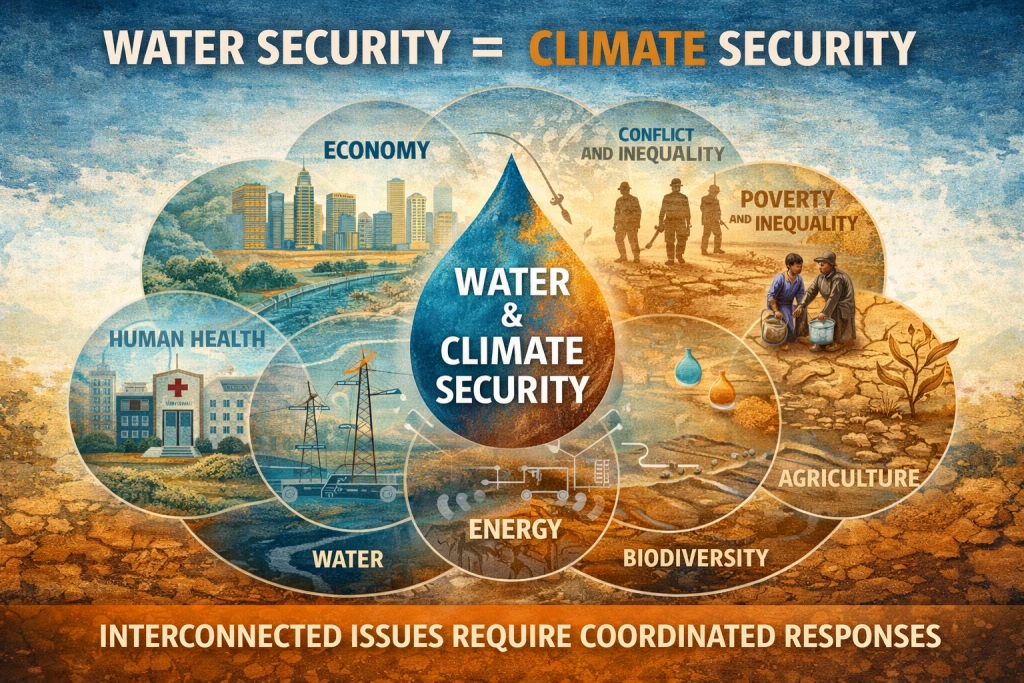
1. Water Security = Climate Security
A dominant message across World Water Day 2026 was the recognition that water is the primary channel through which climate change is experienced. Across UN agencies, governments, and development partners, increasing floods, prolonged droughts, and shifting hydrological systems were highlighted as immediate and escalating risks. The narrative has clearly shifted from anticipating climate impacts to responding to an ongoing crisis, particularly in vulnerable regions such as the Horn of Africa. Where climate shocks affects millions of the popilations. Water is no longer viewed as a sub-sector of climate—it is the system through which climate risks manifest, affecting food systems, energy production, ecosystems, and human settlements simultaneously.
There is no climate adaptation without water.
2. Groundwater Is Finally Getting the Spotlight
One of the most notable shifts reflected in World Water Day 2026 messaging is the growing recognition of groundwater as a strategic resource for water security and climate resilience. Global and regional institutions, including UNESCO, World Bank, African Ministers’ Council on Water (AMCOW), and Intergovernmental Authority on Development, (IGAD) have consistently emphasized groundwater as an invisible but critical buffer against climate variability. This aligns with earlier global evidence, including the UNESCO World Water Development Report, which highlighted groundwater as the world’s largest source of freshwater.
However, this increased visibility is accompanied by growing concern over unsustainable abstraction, declining water quality, and significant data gaps that limit effective management. Across platforms, the narrative is shifting—from viewing groundwater as an emergency or backup resource to recognizing it as a central pillar of water systems that requires governance, monitoring, and long-term investment.
Groundwater is not a backup—it is the system.
3. Equity and Access Remain the Core Crisis
Despite technological advances and policy frameworks, World Water Day 2026 reaffirmed that access to safe water and sanitation remains deeply unequal. Messaging across UNICEF, NGOs, and civil society focused on the reality that billions still lack basic services, with women and girls disproportionately bearing the burden of water collection. The divide between rural and urban populations, as well as formal and informal settlements, continues to widen, highlighting systemic inequalities in service delivery. This human-centered narrative reinforced that water security is not only a technical or environmental issue but fundamentally a question of justice and dignity.
Water is a human right—but not yet a lived reality.
4. The Urban Water Crisis Is Escalating
Urban water challenges featured prominently in global discussions around World Water Day 2026, particularly in rapidly growing cities across Africa and Asia. Messaging across institutions has consistently highlighted the increasing pressure that rapid urbanization places on water systems. Expanding urban populations, combined with weak planning and regulatory frameworks, are accelerating stress on both surface water and groundwater resources.
Across many cities, particularly in the Global South, this is reflected in unregulated or informal borehole drilling, declining groundwater levels, deteriorating water quality, and increased urban flooding linked to the loss of natural recharge areas. These dynamics are well documented in global urban water and resilience reports, which emphasise that infrastructure expansion alone cannot address these challenges without integrated land-use planning and governance reforms.
The convergence of these issues demonstrates that urban water crises are not merely technical failures, but systemic challenges rooted in fragmented governance, inadequate regulation, and unsustainable urban development pathways.
Urban water failure is a governance and planning failure.
5. Data, Monitoring, and Digital Water Systems
A strong technical and donor-driven narrative reflected in World Water Day 2026 is the critical role of data in effective water management. Messaging across many institutions has consistently emphasized that decision-making must be grounded in reliable, accessible, and timely data. This is particularly critical for groundwater systems, where invisibility and limited monitoring often constrain effective management.
Global and regional initiatives are increasingly prioritizing investments in groundwater monitoring networks, digital water information systems, and platforms. These systems enable the collection, analysis, and sharing of data across institutions and borders, supporting more coordinated and evidence-based responses to water challenges.
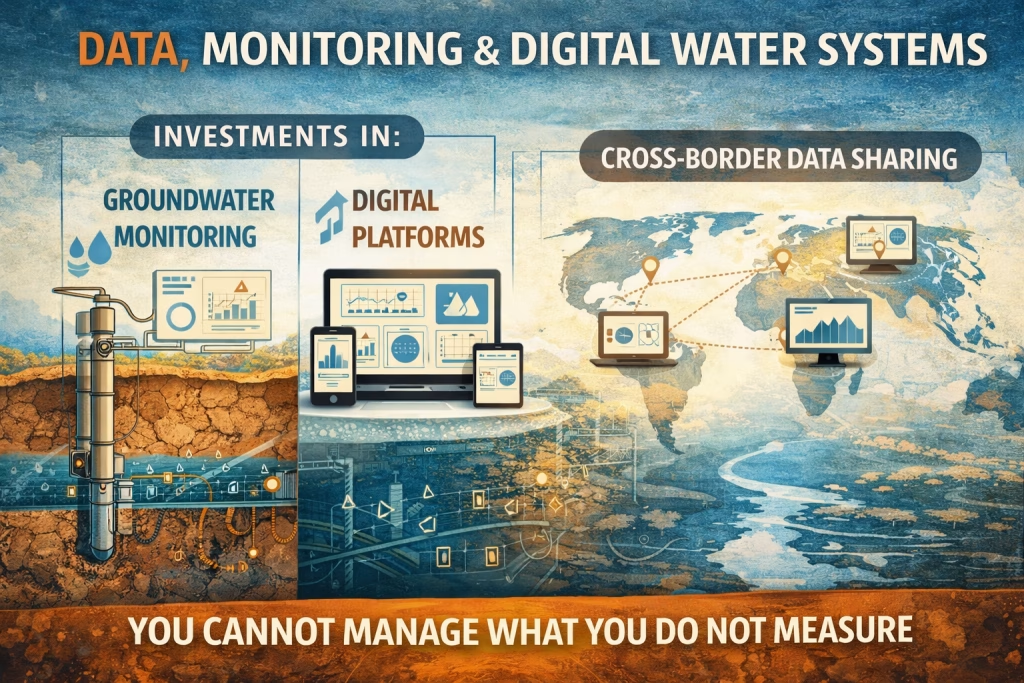
This reflects a broader transition toward data-driven governance, where information is not only collected but actively used to guide policy, planning, and investment decisions. In this context, strengthening data systems is not a technical add-on but a foundational requirement for sustainable water management.
You cannot manage what you do not measure.
6. Nature-Based Solutions and Recharge
Nature-based solutions gained increasing traction during World Water Day 2026, particularly in the context of climate adaptation and sustainable water management. Approaches such as managed aquifer recharge, wetland restoration, and catchment protection were highlighted as effective strategies that work with natural systems rather than against them.
These approaches are increasingly recognized not only for their environmental benefits but also for their cost-effectiveness compared to traditional grey infrastructure. In the context of growing climate variability, NBS offer a critical pathway to improve groundwater recharge, reduce flood risks, and sustain water availability over the long term.
This shift reflects a broader transition toward integrated water resources management, where natural systems are not seen as constraints but as essential components of resilient water infrastructure.
Work with nature, not against it.
7. Financing Water: From Cost to Investment
A significant policy shift highlighted during World Water Day 2026 was the reframing of water from a cost to an investment. Development partners, including the World Bank and GEF, emphasized that water remains underfunded globally despite its central role in economic development and climate resilience. There is growing recognition of the need to de-risk investments, build strong economic cases, and attract both public and private financing. This shift positions water not just as a service to be funded, but as a driver of economic growth and stability.
Water is not a cost—it is an economic multiplier.
8. Science to Policy to Action
Another critical message from World Water Day 2026 was the importance of translating scientific knowledge into policy and action. There was strong emphasis on ensuring that science informs decision-making processes in a clear and actionable way. This requires not only robust research but also effective communication, institutional coordination, and capacity building. The gap between knowledge and implementation remains a major barrier, and closing this gap is essential for achieving meaningful impact.
Despite significant advances in scientific understanding, a persistent gap remains between knowledge production and implementation. In many contexts, research findings are not translated into policies, investments, or practical interventions due to fragmented institutional mandates, limited technical capacity, and weak communication pathways. Bridging this gap is increasingly recognized as one of the most critical challenges in water governance and climate adaptation.
It is within this context that platforms such as JFT Academy place a strong focus on science-to-policy engagement. Through a strong focus on science communication, professional capacity development, and decision-support tools, JFT Academy ensures that knowledge is transformed into understanding, action, and real-world impact. This approach reflects a broader shift toward outcome-driven science, where the value of research is defined not only by publication, but by its ability to influence policy, guide investments, and improve real-world outcomes.
Science must move beyond knowledge to action.
9. Youth and Public Engagement
Social media platforms and public discourse during World Water Day 2026 reflected a growing role for youth and citizen engagement. Younger generations are increasingly demanding accountability, climate justice, and transparency in water governance. Storytelling has become more personal and localized, highlighting real experiences of water insecurity and grassroots solutions. This shift indicates that water is no longer just a technical issue discussed by experts, but a societal issue driven by public demand and collective action.
Beyond advocacy, youth are emerging as key drivers of innovation in the water sector. From developing low-cost water monitoring technologies and digital platforms, to promoting community-based solutions and climate-smart practices, young professionals and entrepreneurs are actively contributing to solving water challenges. Storytelling has also evolved—becoming more personal, localized, and solution-oriented—highlighting lived experiences of water insecurity alongside practical, grassroots innovations.
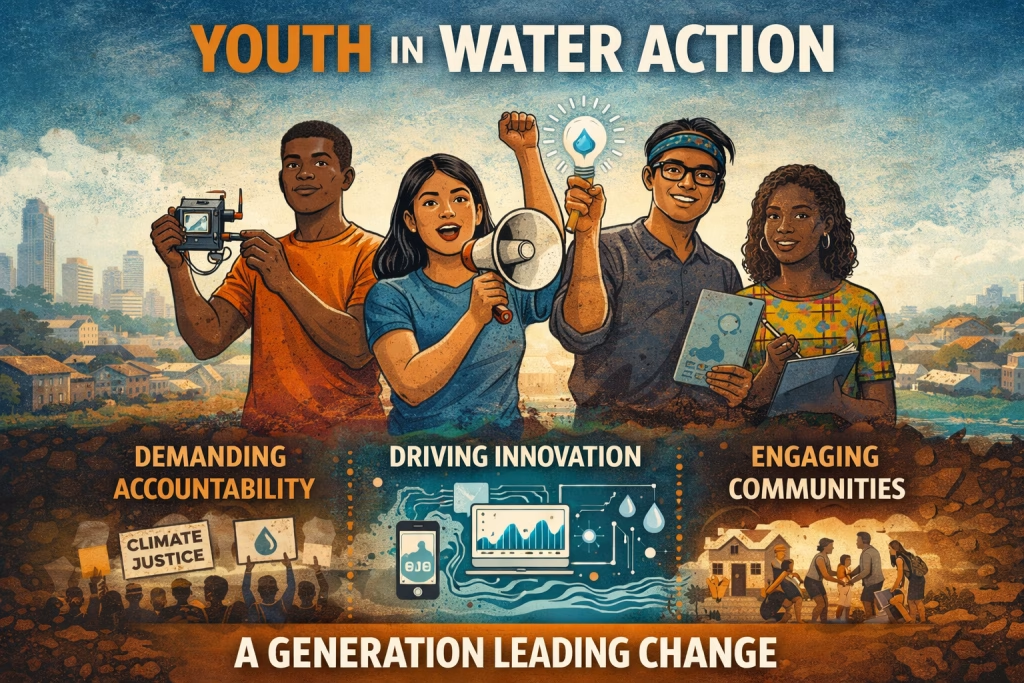
This shift signals a broader transformation in water governance, where water is no longer treated solely as a technical issue addressed by experts, but as a societal challenge shaped by public engagement, innovation ecosystems, and collective action. Youth are not only raising awareness but are increasingly influencing solutions, investments, and policy discourse.
Water action is becoming more urgent, innovative, and driven by collective and youth-led solutions.
The convergence of messages from World Water Day 2026 signals a defining moment in global water governance. Water is no longer peripheral—it is the system that underpins climate resilience, economic development, and human survival. The era of awareness has passed; what lies ahead is an era of accountability, where success will be measured not by commitments, but by implementation, impact, and sustained change.
Final Reflection: The time for water action is now.

I am an expert at the science–policy interface on groundwater governance, water security, and climate resilience, with a focus on African and climate-vulnerable contexts. My work involves applied hydrogeological analysis, risk assessment, decision support, and institutional strengthening, including engagement in transboundary groundwater dialogue and regional cooperation processes. I contribute to programme design, policy dialogue, and capacity development, translating groundwater data and systems understanding into actionable guidance for governments, development partners, and implementing agencies.
 English