

A borehole in Kenya can give a home, school, farm or business reliable water for decades. It can also become one of the most expensive mistakes a property owner makes — a dry hole, salty water, a pump that burns out, or a fine for drilling without approval. The difference usually comes down to decisions made before the drilling rig arrives.
As a hydrogeologist, I am often asked: “How much does a borehole cost, and where do I start?” This guide walks you through every stage of getting a borehole in Kenya — the permits, the survey, realistic costs and the mistakes I see most often — so you can plan with confidence.
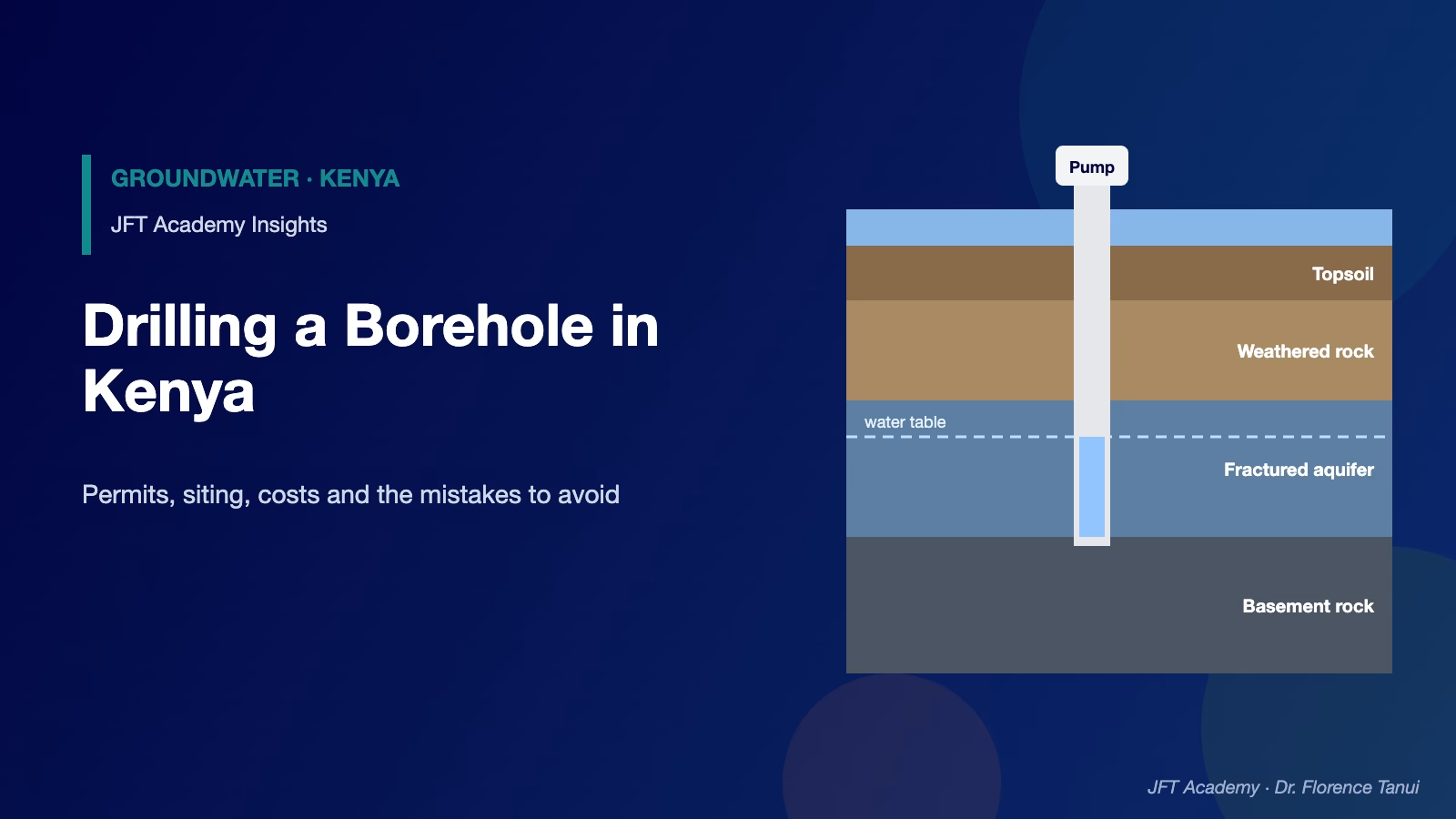
In short: commission a hydrogeological survey from a licensed hydrogeologist, get the required approvals (including Water Resources Authority authorisation) before drilling, hire a licensed contractor, insist on proper test pumping and water quality testing, and obtain your water use permit before you start abstracting.
First, understand what you are drilling into
Groundwater is not an underground lake waiting under every plot. It sits in the pores and fractures of rocks and sediments called aquifers, and Kenya’s geology varies enormously from place to place. Broadly, you will find:
- Volcanic aquifers in much of the Rift Valley and around Nairobi, where water moves through fractured lavas and pyroclastic layers.
- Basement aquifers in large parts of central, eastern and western Kenya, where water is held mainly in weathered zones and fractures of old crystalline rocks — yields can vary greatly over short distances.
- Sedimentary aquifers along the coast and in the north-east, where sandstones and limestones can hold large volumes, but saline water is a common risk.
- Alluvial aquifers along rivers and lugga beds — such as the Lodwar alluvial aquifer I studied for my PhD — which can be very productive but are closely linked to river flows and vulnerable to pollution.
This is why a borehole in Kenya that succeeds on one plot can fail next door, and why the survey matters so much.
The legal process for a borehole in Kenya: permits and approvals
Under the Water Act 2016, anyone planning to drill a borehole must first commission a hydrogeological survey by a licensed expert, and drilling without a permit from the Water Resources Authority (WRA) is an offence. Approval also matters for good reason: in some areas, too many boreholes are drawing on the same aquifer. In Nairobi, for example, the Environment Court has ordered WRA to survey boreholes in Karen and produce an aquifer allocation plan amid concerns about excessive drilling.
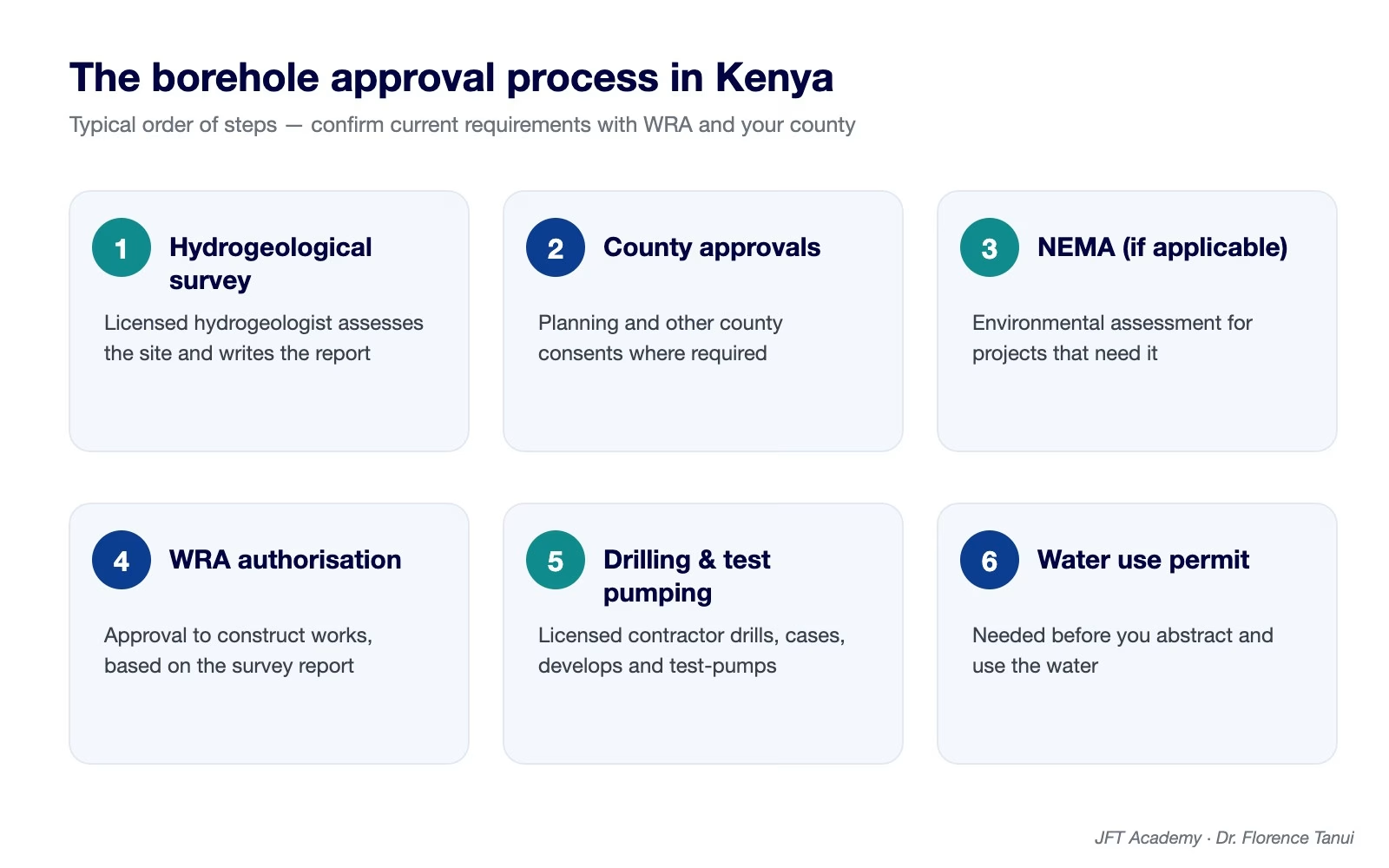
The usual order, as described in recent guidance on the Nairobi process, is:
- Hydrogeological survey by a registered hydrogeologist, confirming whether the site is suitable and has sufficient groundwater.
- County approvals where required (for example planning consent).
- NEMA approval, if your project requires an environmental assessment.
- WRA authorisation to construct the works, supported by the survey report and land documents.
- Drilling by a licensed contractor, followed by casing, development and test pumping.
- Water use (abstraction) permit from WRA before you legally pump and use the water.
A WRA water permit is typically valid for five years and renewable. Always confirm the current requirements and fees directly with the Water Resources Authority and your county, as procedures and charges change.
Timeline: in Nairobi, where approvals are usually stricter, the full process can take three to six months. Start the paperwork well before you need the water.
What happens during a hydrogeological survey?
A good survey is the best money you will spend on a borehole. A qualified hydrogeologist will typically:
- Review geological maps, existing borehole records and any nearby water points.
- Visit the site to look at landforms, rock outcrops, vegetation and drainage.
- Carry out geophysical measurements — most commonly vertical electrical sounding (resistivity) — to identify likely water-bearing zones and their depth.
- Recommend the best drilling point, expected depth, likely yield range and water quality risks.
- Prepare the report required for your WRA application.
Be wary of anyone who promises water “guaranteed” without proper investigation. Groundwater exploration always carries some uncertainty; a professional will explain the risks honestly.
How much does a borehole in Kenya cost?
Costs depend mainly on depth, geology, location, access for the rig and the type of pump you install. Hard rock is slower and more expensive to drill than soft formations, and deep boreholes need more casing. The figures below are indicative ranges drawn from recent published Kenyan cost guides — use them for planning, then get written quotes.
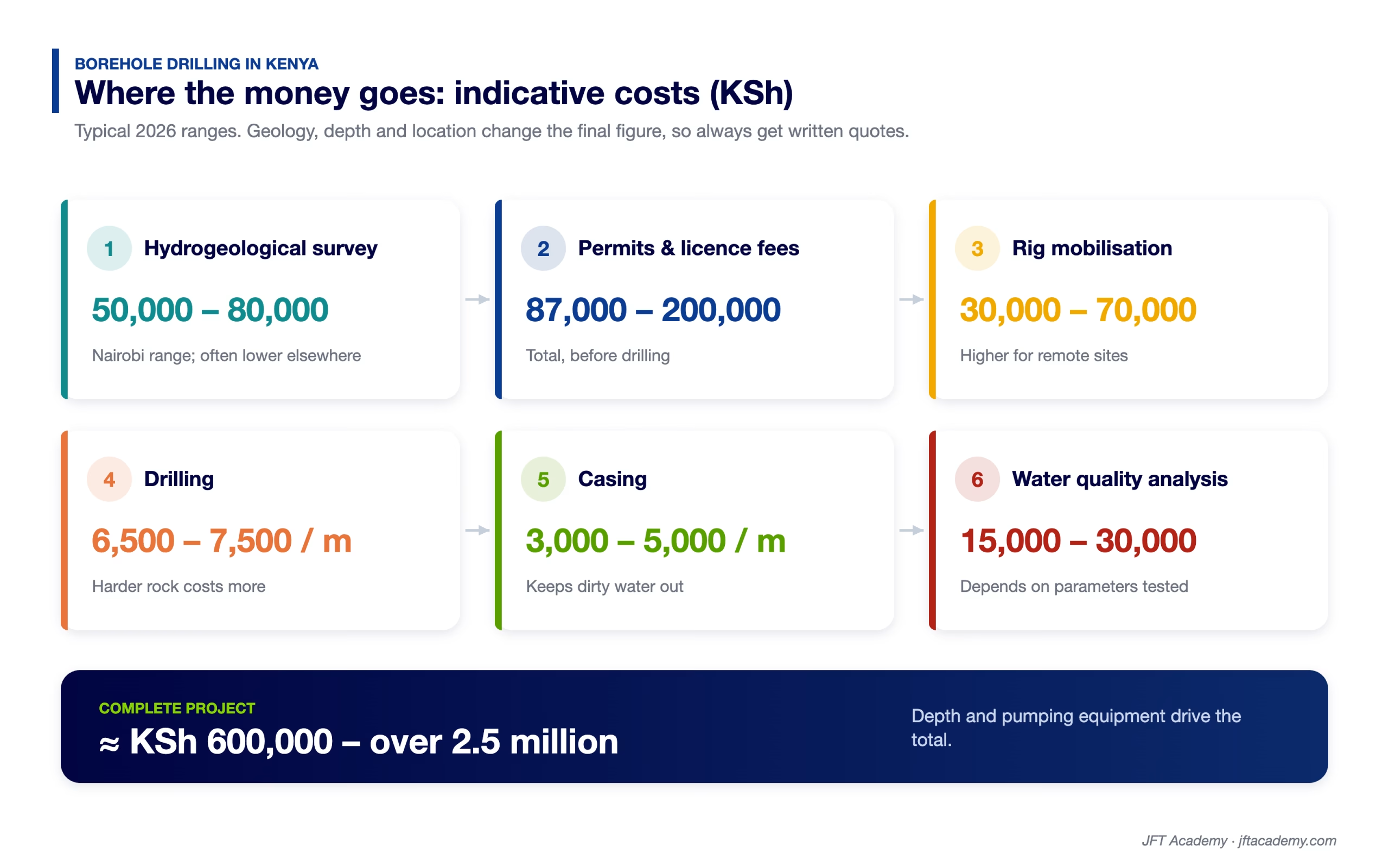
Sources: survey, drilling, casing, mobilisation, water analysis and permit-fee ranges as reported by The Kenya Times (June 2026), citing 2026 Nairobi cost breakdowns. Prices change; treat these as a starting point, not a quote.
Depth is the biggest cost driver
Because drilling is charged per metre, every unnecessary metre adds cost. A good survey helps the driller target the right depth, and a borehole that stops at the right water-bearing zone can be cheaper and more productive than one that simply goes deeper. Deeper is not automatically better.
Choosing a contractor for your borehole in Kenya
- Ask for proof of registration and licensing, and references from recent clients in your area.
- Get at least two written quotations that itemise survey, mobilisation, drilling per metre, casing, gravel pack, development and test pumping.
- Agree in writing what happens if the borehole is dry or yields too little.
- Insist on a borehole completion record: depth, strata encountered, casing and screen positions, water strikes and test-pumping results.
- Make sure the contractor seals the top of the borehole and builds a proper concrete apron and headworks.
Test pumping and water quality: do not skip them
Test pumping tells you how much water the borehole can safely supply and how the water level responds. Without it, people often install a pump that is too large, draw the water down too far and damage the borehole or the pump. Your pump should be sized from the test results, not from guesswork.
Water quality testing tells you whether the water is safe to drink and suitable for its intended use. In parts of Kenya, especially the Rift Valley, naturally high fluoride is a real concern; near the coast, salinity can be a problem; and anywhere, poor siting near latrines or livestock can introduce bacteria. I will cover water testing in detail in a separate guide.
Seven common mistakes when drilling a borehole in Kenya
- Skipping or cheapening the survey. Drilling blind is how properties end up with dry holes.
- Choosing a driller on price alone. Cheap quotes sometimes leave out casing, development or test pumping.
- Drilling before permits are in place. It is an offence, and it can lead to penalties or closure of the works.
- Siting too close to pollution sources. Keep boreholes well away from pit latrines, septic tanks, waste dumps and livestock enclosures — sanitation guidance commonly recommends at least 30 metres, and more in permeable ground.
- No test pumping. You cannot size a pump properly without it.
- Oversized pumps and over-abstraction. Pumping harder than the aquifer can supply lowers water levels and shortens the life of the borehole.
- Ignoring maintenance. Plan for regular servicing, water quality checks and record-keeping from day one.
Thinking beyond your own plot
Every borehole draws on a shared resource. Where many boreholes tap the same aquifer, water levels can decline, neighbours’ wells can dry up and water quality can deteriorate. That is why permits, metering and monitoring matter — not as bureaucracy, but as the basis for managing groundwater fairly. You can read more about this in my articles on groundwater depletion in Africa and groundwater resilience in African cities.
Planning checklist for your borehole in Kenya
Before you sign a contract, run through this checklist. It brings together the key steps in this guide and will help you avoid delays, disputes and unexpected costs.
- Budget realistically. Include the survey, approvals, drilling, casing, test pumping, water testing, pump, storage tank and electrical or solar installation — not just the per-metre drilling rate.
- Commission the survey first. Use the hydrogeologist’s report to decide whether a borehole in Kenya is the right option for your site, or whether rainwater harvesting or a connection to a utility would be better.
- Start the paperwork early. Approvals can take weeks or months, especially in Nairobi and other urban counties.
- Compare at least two quotations line by line, and check what happens if the hole is dry.
- Plan the headworks and site layout so the borehole is protected from flooding, latrines and livestock.
- Agree on records and handover. Insist on the completion record, test-pumping results and water quality report before final payment.
- Plan for maintenance. Set aside a budget for servicing the pump and testing the water every year.
Treat these steps as part of the project, not optional extras. A borehole in Kenya that is planned carefully from the start is far more likely to deliver safe, reliable water for many years.
Frequently asked questions
Do I need a permit to drill a borehole in Kenya?
Yes. You need WRA authorisation before drilling, and a water use permit before you abstract and use the water. Other approvals, such as county consent or NEMA approval, may also apply.
How deep should a borehole be?
There is no single answer. The right depth depends on where water-bearing zones occur at your site, which the hydrogeological survey and the driller’s observations during drilling will indicate.
How long does the whole process take?
Drilling itself often takes only days, but approvals can take weeks to months. In Nairobi, the full process may take three to six months.
Can a borehole run dry?
Yes — especially if the aquifer is over-pumped, if many boreholes draw on the same aquifer, or during long droughts. Proper siting, test pumping, sensible pump sizing and monitoring reduce the risk.
Final word
A borehole in Kenya is a long-term investment in water security. Treat it like one: start with science, follow the law, hire professionals, test the water and look after the system. Done well, it will serve your family, institution or community for many years.
This article provides general guidance and does not replace a site-specific hydrogeological assessment. Costs and regulatory requirements change — always confirm with the Water Resources Authority, your county and licensed professionals.