

You have worked hard for your degree. You have passed exams in hydrogeology, GIS, environmental chemistry and research methods. Then you sit down to write your graduate CV and it looks like… a list of courses. If that feels familiar, you are not alone — it is one of the most common problems I see when mentoring geoscience and environmental graduates.
The good news is that you almost certainly have more to offer than your CV shows. You just need to translate what you have done into the language employers use. This guide shows you how, step by step.
Why a “course-list CV” does not work
Recruiters and hiring managers scan CVs quickly. In those first seconds they are not asking “What did this person study?” — your degree title already answers that. They are asking: “Can I trust this person with real work, and will they add value quickly?”
A list of modules cannot answer that question. Evidence of what you have done with your knowledge can. That evidence is already in your thesis, fieldwork, lab work, group projects, volunteering and even part-time jobs. Your task is to surface it.
Step 1: Use the capability formula
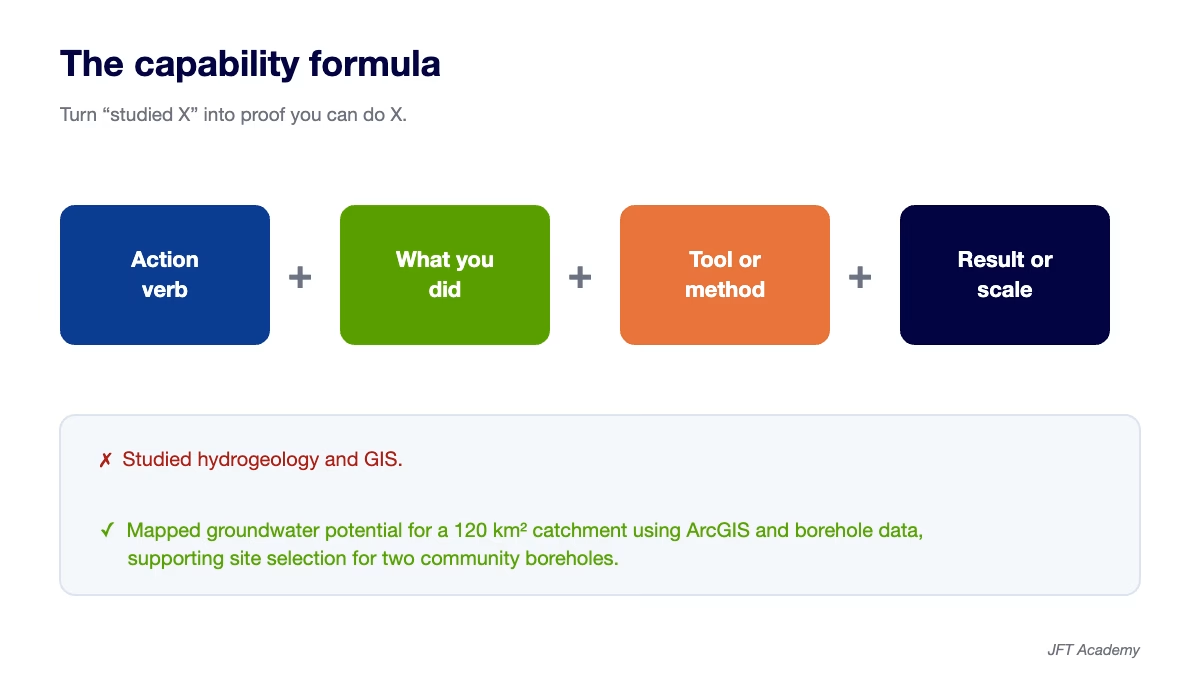
For every meaningful thing you have done, write one line using this structure: action verb + what you did + tool or method + result or scale. Here are examples from typical geoscience and environmental degrees:
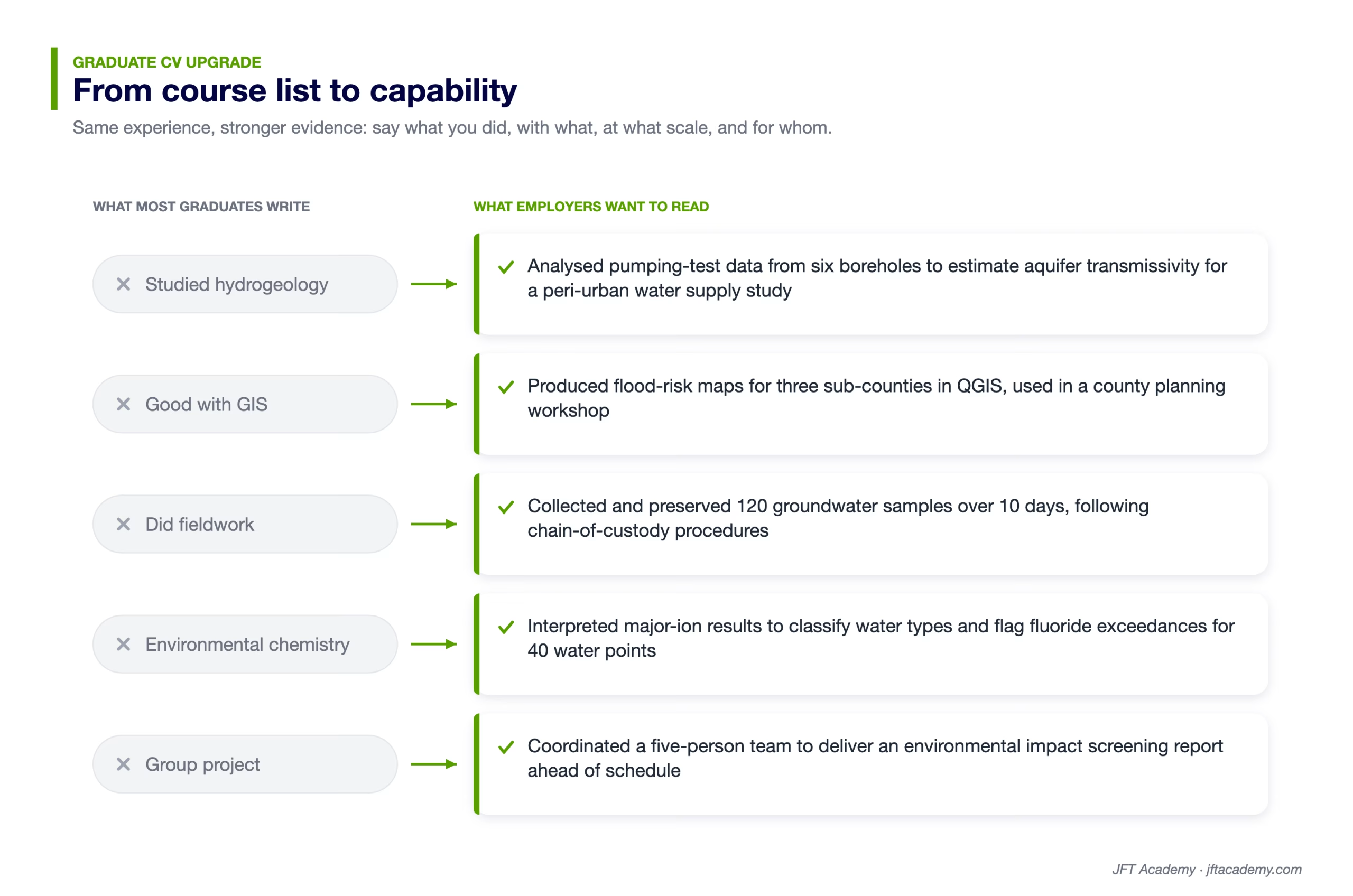
No numbers? Estimate scale honestly: the size of the area you mapped, the number of samples, the length of a dataset, or the number of people reached. Specific details make claims believable.
Step 2: Mine your degree for hidden experience
Go through your university years and list everything that involved doing, not just learning. Common sources include:
- Your thesis or final-year project — research design, data collection, analysis, software and conclusions.
- Field courses and mapping exercises — logging, sampling, navigation, safety and teamwork.
- Laboratory work — methods, instruments, quality control.
- Attachments and internships — even short ones count.
- Volunteering — community water projects, environmental clean-ups, tree planting, school outreach.
- Student leadership — clubs, associations, class representative roles, event organising.
- Part-time jobs — customer service, data entry or tutoring all show reliability and communication.
Step 3: Structure your graduate CV for a two-page scan
Header
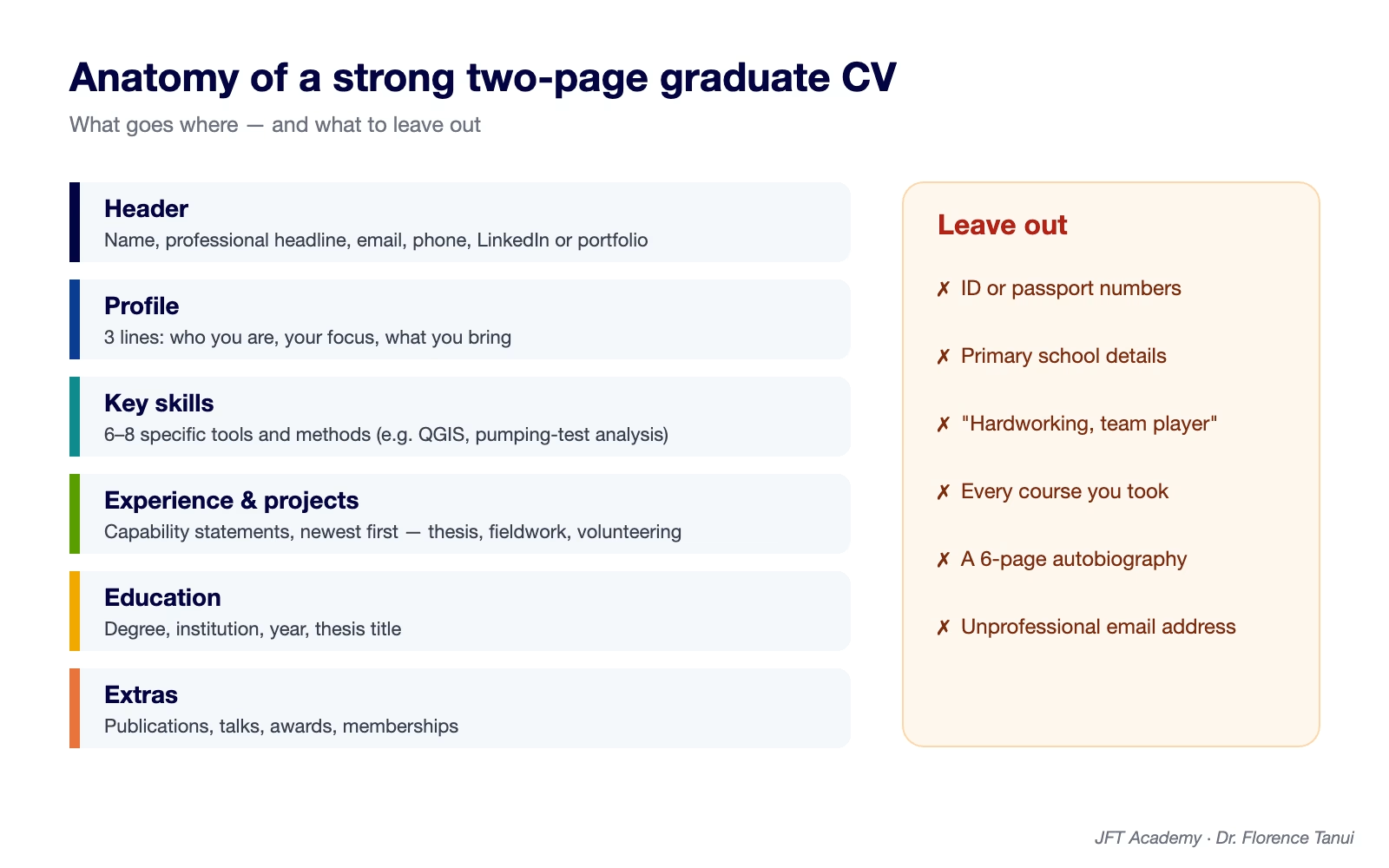
Your name, a professional headline (for example, “Geologist | Groundwater & Environmental Assessment | GIS”), a professional email address, phone number and a LinkedIn or portfolio link. You do not need your ID number, date of birth or a full home address.
Profile (three lines)
Who you are, what you focus on and what you bring. Example: “BSc Geology graduate with field and laboratory experience in groundwater quality assessment. Skilled in QGIS, hydrochemical interpretation and technical reporting. Seeking a graduate role in water resources or environmental consulting.”
Key skills
Six to eight specific skills that match the roles you want — software, methods and techniques. “QGIS, ArcGIS, AquiferTest, hydrochemical data analysis, borehole logging, technical report writing” is far more useful than “hardworking, team player, fast learner”.
Experience and projects
This is the heart of your CV. List your thesis, attachments, fieldwork, volunteering and projects as experience entries, each with two to four capability statements. Newest first.
Education
Degree, institution, year and thesis title. Include your class of degree if it helps you. Relevant short courses can go here too.
Extras
Publications, conference posters or talks, awards, professional memberships and languages. Leave out generic hobbies unless they genuinely support your application.
Step 4: Tailor every application
Read each job advert carefully and highlight the key words — tools, tasks and qualities. Then make sure the top third of your graduate CV (headline, profile and skills) speaks directly to them. One CV sent to every job is like one key for every door: it opens very few. Keep a master CV with everything, and create a tailored version for each role.
Step 5: Build the experience you are missing
If your graduate CV still feels thin, create experience on purpose. Offer a defined mini-project to an organisation you admire (“Could I analyse last year’s water-level data and share a two-page summary?”), turn your thesis into a short article or poster, join a professional association and volunteer for a committee, or take an applied short course that produces something you can show. In two or three months you can add several strong lines to your CV.
Common graduate CV mistakes to avoid
- Long objective statements that talk about what you want rather than what you offer.
- Listing every course unit you took.
- Unexplained acronyms and technical jargon in every line.
- Spelling errors — always ask someone to proofread.
- Unprofessional email addresses.
- Files named “CV final FINAL v3.pdf”. Use “Firstname-Lastname-CV.pdf”.
- Photos, ID numbers and personal details that are not needed.
Before and after: a short example
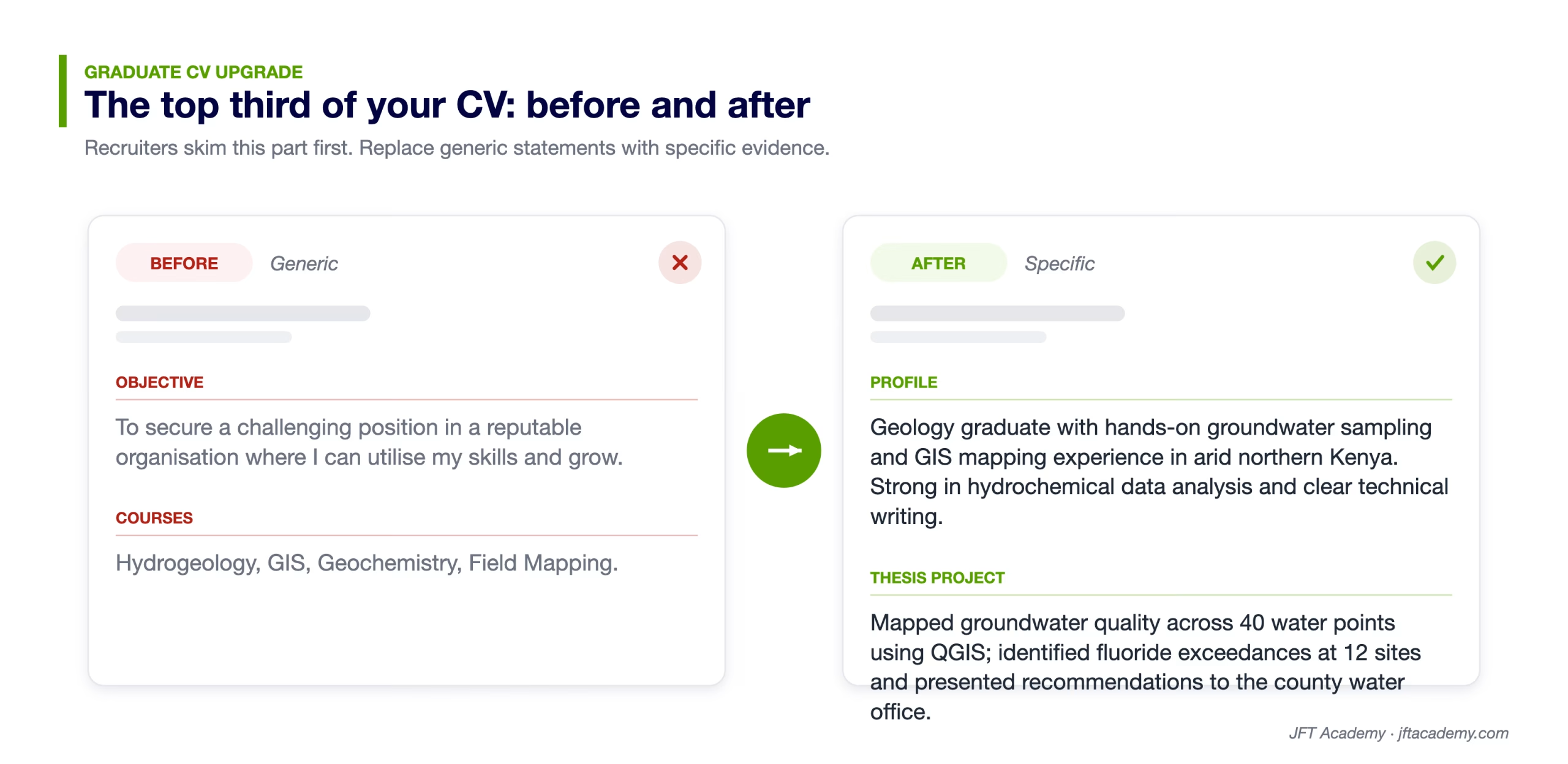
Graduate CV checklist before you hit send
Use this quick checklist every time you submit an application. A few minutes of checking can be the difference between a graduate CV that is shortlisted and one that is skipped.
- Does the headline and profile match the role you are applying for?
- Does every experience entry use capability statements with tools and results?
- Have you included your thesis, fieldwork and volunteering as experience?
- Are your key skills specific (software, methods) rather than generic?
- Is your graduate CV two pages or less, with clear headings and consistent formatting?
- Have you removed unnecessary personal details such as ID numbers?
- Has someone else proofread it for spelling and clarity?
- Is the file saved as a PDF with a professional name?
Keep a master graduate CV with everything you have done, and tailor a copy for each application. Over time, as you add new projects and roles, your graduate CV will evolve into a strong professional record.
Further reading: browse the example CVs on Prospects to see how other graduates present coursework, projects and placements, then adapt the best ideas to your own graduate CV.
Frequently asked questions
How long should a graduate CV be?
Two pages is ideal for most graduate roles. Academic CVs for research positions can be longer because they include publications and presentations.
Should I include my grades?
Include your class of degree if it is strong or required by the employer. You do not need to list grades for individual units.
What if I have no internship at all?
Use your thesis, fieldwork, lab work, volunteering and student leadership as experience — and start creating new experience now through mini-projects and volunteering.
Take the next step
A capability-based graduate CV is just one part of launching your career. In my free self-guided programme Career Launchpad, you will also set a 12-month direction, build visibility, form a personal advisory circle, prepare interview stories and create a 90-day career plan. You may also find these articles helpful: How to Build a Personal Brand and Positioning for Opportunity.
Your degree opened the door. Your CV should show what you can do once you walk through it.