

Decision-makers are busy. A county water director might receive dozens of reports in a month, attend back-to-back meetings and make budget choices under pressure. A 120-page technical report, however excellent, is unlikely to be read in full. A clear, well-structured one-page policy brief often is.
The one-page evidence brief — often called a policy brief — is one of the most powerful tools a scientist can master. It turns months or years of research into something a decision-maker can understand and act on in a few minutes. Here is how to write one, with a template you can use today.
What a one-page policy brief is — and is not
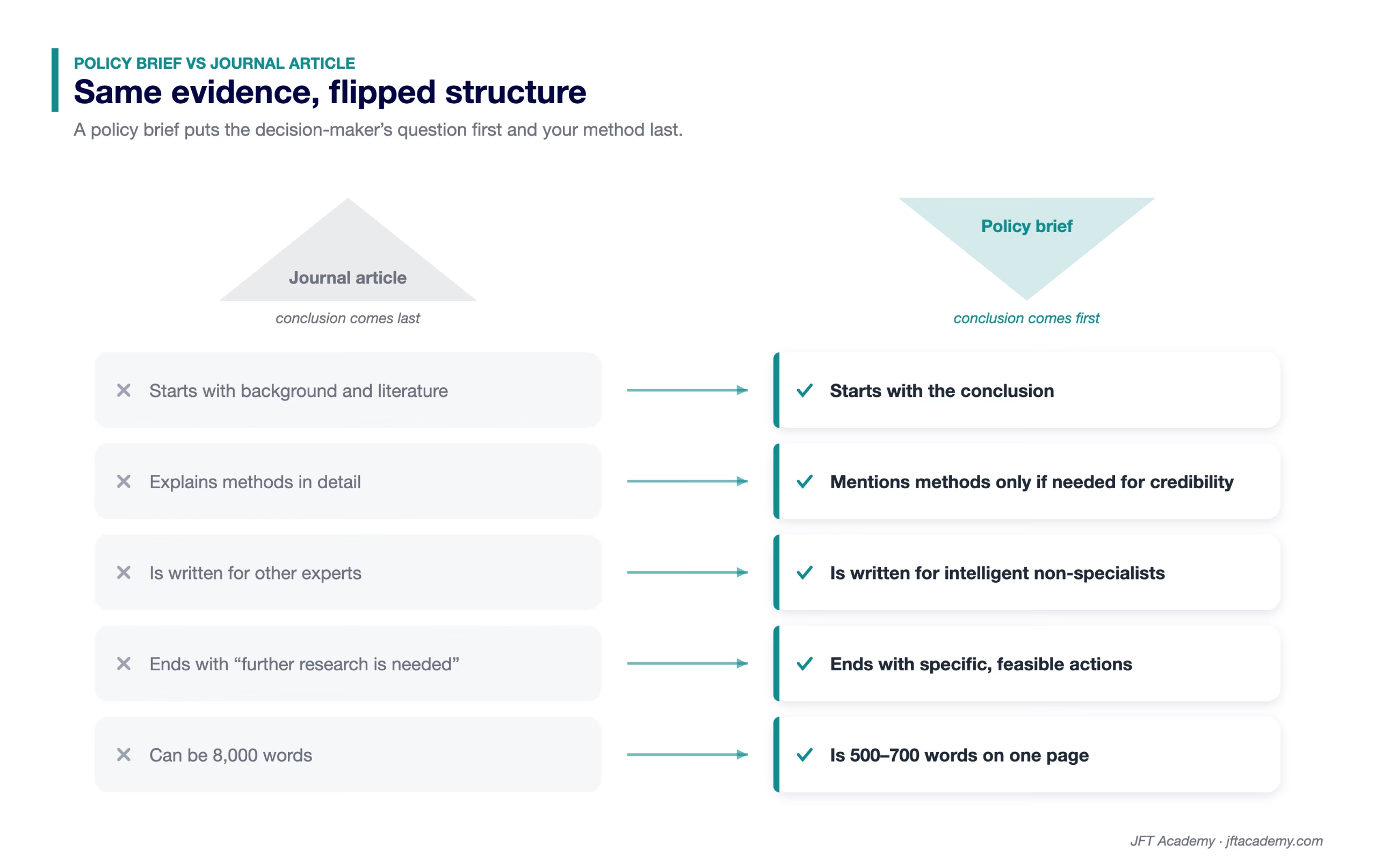
A good brief is a short, plain-language summary of evidence, written for a specific decision and a specific reader. It is not a shortened journal article, a project progress report or an advocacy flyer. It should be accurate, balanced and practical.
Before you write: three questions
- Who exactly is the reader? A county executive committee member, a ministry technical officer, a development partner, a utility manager? Write for one real person.
- What decision are they facing, and when? A budget, a plan, a permit, a policy review? Timing matters — evidence that arrives after the decision has little effect.
- What do you want them to do? If you cannot answer this in one sentence, you are not ready to write.
The policy brief template: six blocks on one page
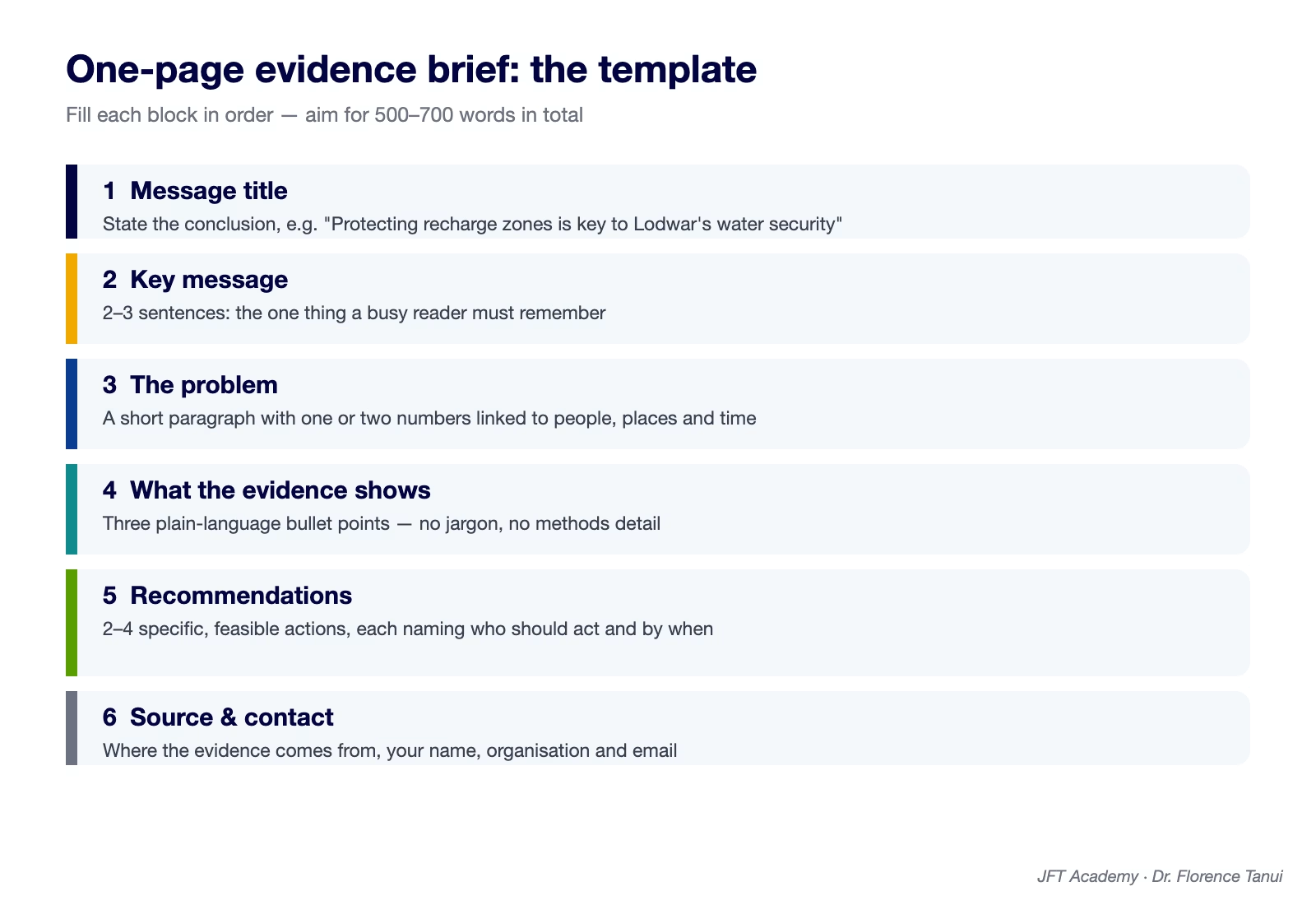
1. A message title
Your title should state the conclusion, not the topic. Compare “Groundwater in Lodwar” with “Protecting riverbed recharge zones is key to Lodwar’s water security”. The second tells the reader the point before they read a single paragraph.
2. Key message (two to three sentences)
This is the most important text on the page. If the reader stops here, they should still know the problem, your main finding and what should happen next. I teach this as the three-sentence core message: the problem, your insight, so what.
3. The problem
One short paragraph explaining why this matters now, with one or two well-chosen numbers connected to people, places and time. Instead of “groundwater levels decline by 0.5 m per year”, write “if current trends continue, many shallow boreholes in the town could run dry within the next decade”.
4. What the evidence shows
Three bullet points in plain language. Each should be a finding, not a method. Avoid jargon or explain it briefly. A single simple chart or map can help if it has a clear message headline.
5. Recommendations
Two to four actions that are specific, feasible and assigned. Each should say who should do what, ideally by when. “Improve groundwater management” is a wish; “The county water department should map and gazette the main recharge zones within the next planning cycle” is a recommendation.
6. Source and contact
Where the evidence comes from (your study, dataset or report, with a link), your name, organisation and contact details. This builds credibility and invites follow-up.
A short worked example
Protecting riverbed recharge zones is key to Lodwar’s water security
Key message: Lodwar depends almost entirely on a shallow alluvial aquifer that is under growing pressure from population growth and drought. Evidence shows it is recharged mainly by seasonal river flows, making it vulnerable to over-pumping and pollution. Protecting the riverbed recharge zone should be a priority in county water and land-use planning.
Recommendations (example): map and protect recharge areas; regulate sand harvesting and waste disposal along the riverbed; monitor water levels and quality at key boreholes; and review abstraction permits against sustainable yield.
This example is simplified for illustration; a real brief would cite the underlying study and data.
Writing tips that make a difference
- Lead with the conclusion. Scientists are trained to build up to a finding. Policy readers need it first.
- Short sentences, active voice. “We recommend monthly monitoring” beats “It is recommended that consideration be given to enhanced monitoring protocols”.
- One idea per paragraph. White space is your friend.
- Be honest about uncertainty. Use clear phrases such as “likely”, “we are confident that” or “more data are needed on…”. Credibility is your most valuable asset.
- Use visuals sparingly. One clear chart or map with a message headline is better than three busy ones.
- Design for scanning. Headings, bold key phrases and bullet points help readers find what they need.
Test it before you send it
Give your draft policy brief to someone outside your field and ask them to read it for two minutes. Then ask: what is the main message, and what is the main recommendation? If they cannot answer clearly, revise. This simple “two-minute test” catches most problems.
Getting your policy brief to the right people
A policy brief sitting in your inbox changes nothing. Share it in person where possible, attach it to meeting invitations, present it at stakeholder forums or technical working groups, and send a short, personal email rather than a mass mailing. Timing it to the policy calendar — budget cycles, county integrated development planning, consultations — dramatically increases its chances of being used. I discuss this further in Science Communication 101 in Water and Why Isn’t Your Scientific Project Funded?.
Common mistakes
- Trying to include everything from the full report.
- Recommendations that are vague or impossible to implement.
- No clear reader or decision in mind.
- Dense paragraphs and unexplained acronyms.
- Spreading onto two or three pages — if it does not fit, cut.
Policy brief checklist
Before you share your policy brief, check it against these questions:
- Does the title state the conclusion rather than the topic?
- Can a busy reader understand the key message in under 30 seconds?
- Is there one clear reader and one clear decision in mind?
- Are the numbers connected to people, places and time?
- Are the recommendations specific, feasible and assigned to someone?
- Is it free of unexplained jargon and acronyms?
- Does it fit on one page, with a source and contact line?
A strong policy brief is short, focused and useful. If every block on your page passes this checklist, your evidence has a much better chance of shaping real decisions.
Further reading: IDRC’s guide on how to write a policy brief includes a template and real examples from African research projects.
Frequently asked questions
How long should a policy brief be?
A one-page brief is typically 500–700 words. Longer policy briefs (two to four pages) exist, but a single page is often the most effective format for busy decision-makers.
Should I include references?
Include a short source line and a link to the full study or report. Detailed reference lists belong in the technical report.
Can I include charts?
Yes — one simple chart or map with a clear message headline can be very effective. Avoid complex figures copied straight from a paper.
Learn to make your science speak
The one-page brief is one of the core skills in my free self-guided programme Make Science Speak, alongside audience analysis, three-sentence core messages, storytelling, charts that speak and funder-ready language. Bring one piece of your own research, and by the end of four weeks you will have a brief ready to share.
Good evidence deserves to be used. Make it easy for decision-makers to use yours.