

Kenya’s October–November–December “short rains” matter far beyond farming. They refill rivers, dams and — crucially — the aquifers that supply boreholes and wells for millions of people. This year, the season is unfolding against the backdrop of a strong El Niño, and the implications for groundwater are both promising and risky.
In this article I summarise what the forecasts say, explain how heavy rainfall affects groundwater, and set out practical steps for borehole owners, water managers and counties.
What the short rains forecasts say
The Kenya Meteorological Department’s outlook for the October–December 2026 short rains, issued on 31 August 2026, indicated above-average rainfall over many counties, with rains expected to continue into January and temperatures warmer than average. The outlook was presented at the 13th National Climate Outlook Forum.
Two large-scale climate drivers are behind this. Forecasters pointed to a high probability of a very strong El Niño and a positive Indian Ocean Dipole during the season — a combination historically linked to wetter short rains in East Africa. KMD’s November forecast, reported at the start of the month, pointed to above-normal rainfall across most of the country and warmer-than-average temperatures, while El Niño was expected to peak around December 2026 and could persist into early 2027.
A note of caution: KMD has stressed that a very strong El Niño does not automatically translate into torrential rainfall everywhere. Rainfall will vary between and within counties, so always follow the latest daily, weekly and county forecasts.
This is a sharp contrast with last year. KMD described the 2025 short rains as one of the driest in recent years, with most of the country receiving less than 40 per cent of the long-term mean in November 2025. After a dry season, many aquifers start this season with lower water levels — which makes recharge this year especially valuable.
For a wider explanation of the global event, see my earlier article on Super El Niño 2026.
How rainfall becomes groundwater
Only part of the rain that falls ever reaches an aquifer. Some runs off into rivers and drains, some evaporates, some is used by plants, and the rest infiltrates the soil and slowly percolates down to the water table. How much recharge occurs depends on:
- Rainfall intensity and duration: steady rain over several days often recharges more than a single violent storm that mostly runs off.
- Soil and geology: sandy soils, fractured volcanic rocks and alluvial riverbeds let water in quickly; clay soils and paved surfaces do not.
- Land cover: vegetation and mulch slow water down and help it soak in; bare, compacted or paved ground increases runoff and erosion.
- River flows: in arid areas such as Turkana, much recharge happens through riverbeds during floods — the process that feeds alluvial aquifers like Lodwar’s.
The opportunity: replenishing aquifers
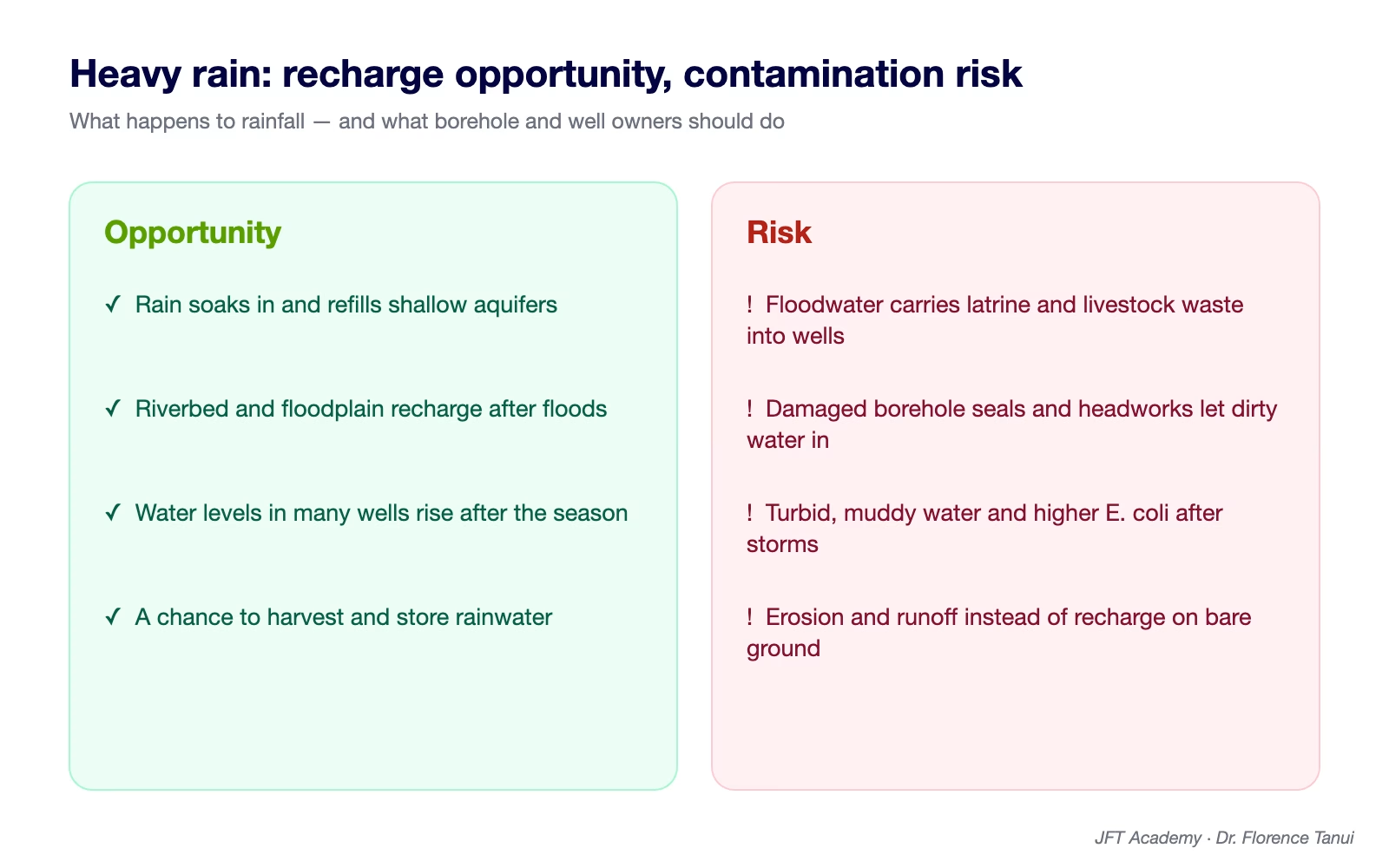
After dry spells, a good rainy season can raise water levels in shallow aquifers, revive springs and improve yields in many boreholes. In arid and semi-arid areas, flood flows along seasonal rivers can recharge alluvial aquifers that communities depend on for the rest of the year.
This is also an opportunity to capture and store water deliberately: rooftop rainwater harvesting, water pans, sand dams and other managed aquifer recharge approaches can turn excess rainfall into stored supply for the dry months ahead.
The risk: contamination, flooding and damaged infrastructure
Heavy rains also bring real threats to groundwater-based water supplies:
- Contamination: floodwater can carry faecal matter from latrines, septic tanks and livestock into shallow wells and poorly sealed boreholes, increasing the risk of cholera and other waterborne diseases.
- Inundated boreholes: where floodwater submerges the borehole head, dirty water can enter directly unless the casing and seal are intact and raised.
- Damaged pumps and power: flooding can damage pumps, solar panels and electrical systems.
- Turbidity: muddy water reduces the effectiveness of chlorination and filters.
- Rising lakes and water tables: in some areas, very high groundwater and lake levels can flood homes and infrastructure — as seen around the Rift Valley lakes. I discuss this in the Lake Baringo and Lake Bogoria merging crisis.
What borehole owners should do during the short rains
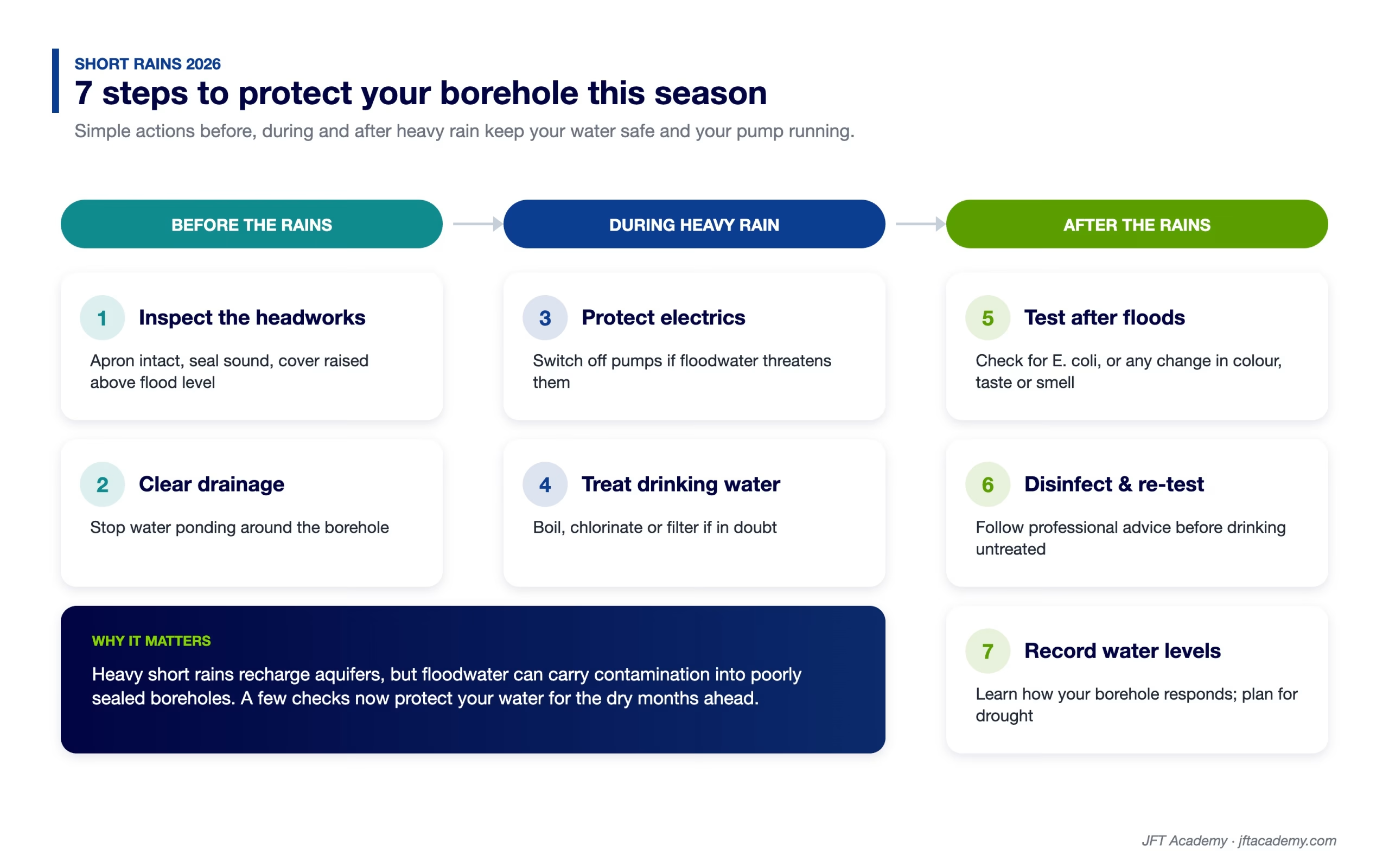
- Inspect the headworks. Check that the concrete apron is intact and sloping away, the sanitary seal is sound and the cover is secure and raised above likely flood level.
- Clear drainage around the borehole so water does not pond nearby.
- Protect electrical equipment and switch off pumps if floodwater threatens them.
- Treat drinking water during and after heavy rain if there is any doubt — boil, chlorinate or use an appropriate filter.
- Test after floods. Have the water tested for E. coli after flooding or any change in colour, taste or smell. See my guide to borehole water testing.
- Disinfect if contaminated, following professional advice, and re-test before drinking untreated water.
- Record water levels before, during and after the season if you can. These simple records help you understand how your borehole responds and plan for drought.
What counties and water utilities can do
- Prioritise water safety: increase water quality monitoring at public boreholes and shallow wells, and prepare chlorination and emergency supply plans for high-risk areas.
- Protect recharge zones: keep riverbeds, wetlands and floodplains free of encroachment, waste dumping and uncontrolled sand harvesting.
- Invest in storage and recharge: support rainwater harvesting, sand dams, water pans and managed aquifer recharge pilots.
- Monitor groundwater levels: use the season to collect data on how aquifers respond — essential for drought planning and permitting.
- Plan for the next dry period: El Niño seasons are often followed by drier conditions. Water captured and protected now will matter later.
Why this matters for long-term water security
Kenya’s rainfall is becoming more variable, swinging between failed seasons and intense rains. Groundwater is our most important buffer against that variability — but only if aquifers are recharged, protected and managed wisely. Every wet season is a chance to strengthen that buffer, and every flood is a reminder that water quality and infrastructure must be protected too. You can read more in Groundwater Resilience in Crisis.
Stay updated: the Kenya Meteorological Department publishes county-level forecasts throughout the short rains. Check them weekly and adjust your borehole and drainage plans as the short rains season develops.
Frequently asked questions
Will heavy rains raise my borehole’s water level?
Often, yes — especially in shallow aquifers and areas with permeable soils or near seasonal rivers. Deep aquifers respond more slowly and may show little change for months.
Is borehole water safe to drink during floods?
Not necessarily. Floodwater can contaminate wells and boreholes. Treat drinking water if in doubt and test after flooding.
Where can I find official forecasts?
Follow the Kenya Meteorological Department’s daily, weekly, monthly and county forecasts and advisories at meteo.go.ke.
Final word
The 2026 short rains could be a welcome turnaround after last year’s drought — or a source of floods and disease where water sources are poorly protected. With a few practical steps, borehole owners and water managers can make the most of the recharge opportunity while keeping water safe.
Forecast information in this article reflects official outlooks and reporting available in mid-November 2026. Always check the latest Kenya Meteorological Department advisories for your county.