

Early in your career, it is easy to believe that leadership starts when someone gives you a title: team leader, project manager, head of department. Until then, you wait. In my experience, it works the other way round. People are usually given leadership roles because they have already been practising leadership without a title — quietly, consistently and without being asked.
Leadership is a set of behaviours, not a position. For scientists and technical professionals, those behaviours are what turn a capable analyst into someone colleagues trust, partners seek out and managers want to promote. Here are seven habits of leadership without a title that you can start practising this week, whatever your role.

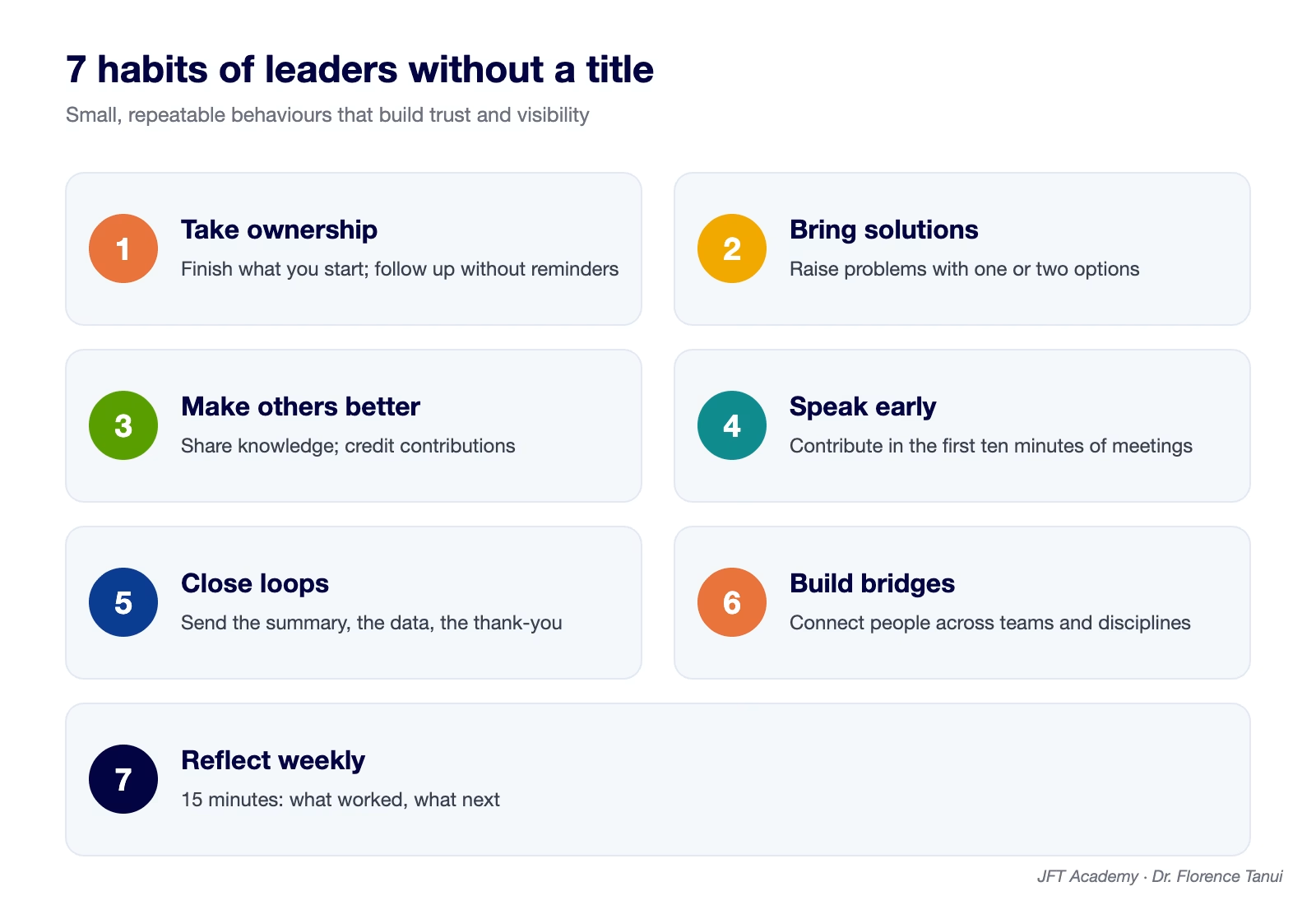
1. Take ownership
Ownership means treating your work as yours — from start to finish. You meet deadlines or flag problems early. You follow up without being chased. When something goes wrong, you say so and help fix it rather than looking for someone to blame.
In technical work, ownership shows up in small details: checking your data before sending it, documenting your methods so others can repeat them, and closing the loop with field teams. These habits build a reputation for reliability, which is the foundation of every leadership role.
Try this: choose one task this week and own it completely — including the follow-up nobody asked you to do.
2. Bring solutions, not just problems
Anyone can point out what is wrong. Leaders also suggest what could be done. You do not need the perfect answer — offering one or two options shows that you have thought it through and makes it easier for others to decide.
Instead of: “The sampling schedule will not work.” Try: “The current schedule clashes with the rains. We could start two weeks earlier or split the sites between two teams — which would you prefer?”
3. Make others better
Strong leaders raise the performance of the people around them. Share what you know, explain how you solved a tricky analysis, help a newcomer find their feet and give credit generously. When a colleague’s idea works, say so publicly.
This is especially powerful in science, where knowledge is often guarded. Being known as the person who helps others succeed builds trust and influence far beyond your job description.
4. Speak early
Many capable early-career professionals — and many women in geoscience and STEM — wait too long to speak in meetings, until the moment has passed. Make it a habit to contribute something within the first ten minutes: a question, a data point or a brief comment. It gets easier with practice, and it signals that your perspective belongs in the room.
Preparation helps. Before an important meeting, write down one point you want to make and one question you want to ask. I explore this further in Women in Science Leadership in Africa.
5. Close loops
Closing loops means finishing the small things that keep work moving: sending meeting notes, sharing the dataset you promised, confirming next steps, thanking people who helped. These actions take minutes but signal professionalism and respect.
Many projects stall not because of big failures but because small follow-ups slip through the cracks. The person who reliably closes loops becomes the person everyone wants on their team.
6. Build bridges
Today’s challenges — water security, climate resilience, urban growth — cross disciplines and institutions. Leaders connect people: the hydrogeologist with the planner, the researcher with the county official, the engineer with the community chair. Introduce people who should know each other. Attend events outside your immediate field. Learn enough of other disciplines’ language to translate between them.
Bridge-builders often become the natural coordinators of projects, because they understand how the pieces fit together.
7. Reflect weekly
Growth comes from reflection, not just experience. Spend fifteen minutes at the end of each week asking: What went well? What did I learn? What will I do differently next week? Write it down. Over months, these notes become a powerful record of your development — and excellent material for performance reviews and interviews.
Make time for leadership without a title
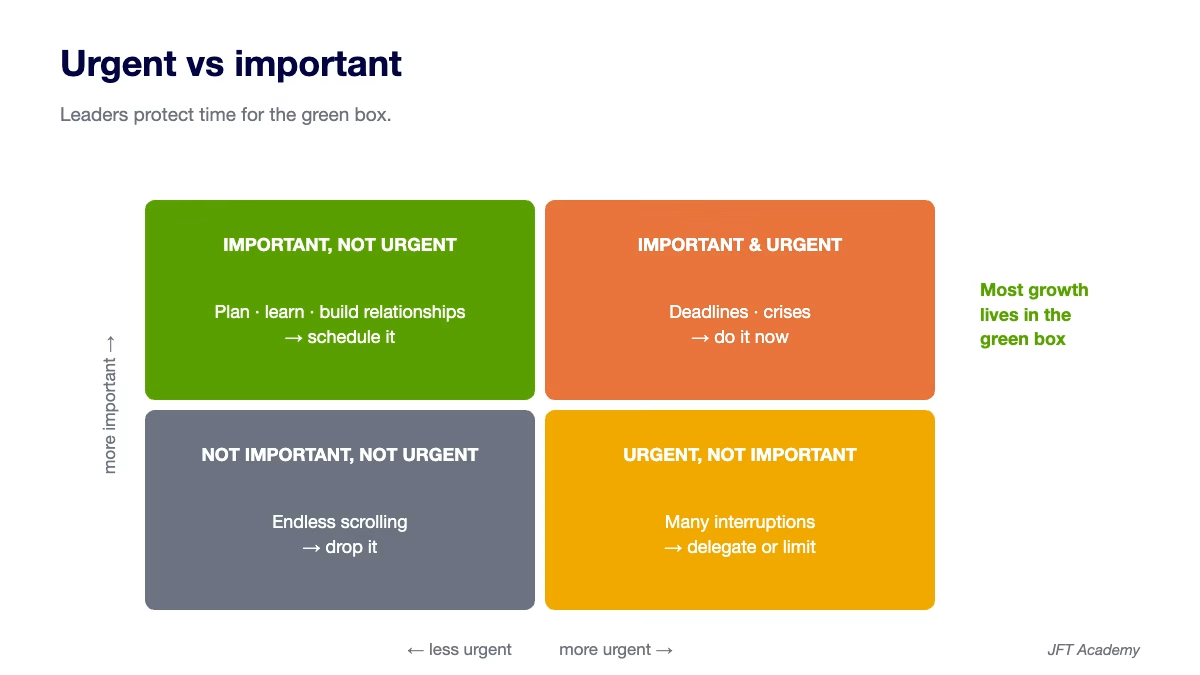
Most of these habits live in the “important but not urgent” box: they rarely shout for attention, so they are easy to postpone. Block small, regular slots in your calendar for reflection, relationship-building and helping others. Leadership is built in these quiet moments.
What leadership without a title is not
- It is not doing everyone else’s work. Helping others is different from taking on their responsibilities.
- It is not overriding your manager. Bring options and ideas respectfully, and support decisions once they are made.
- It is not being the loudest voice. Quiet, consistent reliability often earns more trust than charisma.
- It is not unpaid overtime forever. Leadership includes protecting your energy and setting healthy boundaries.
How leadership without a title pays off
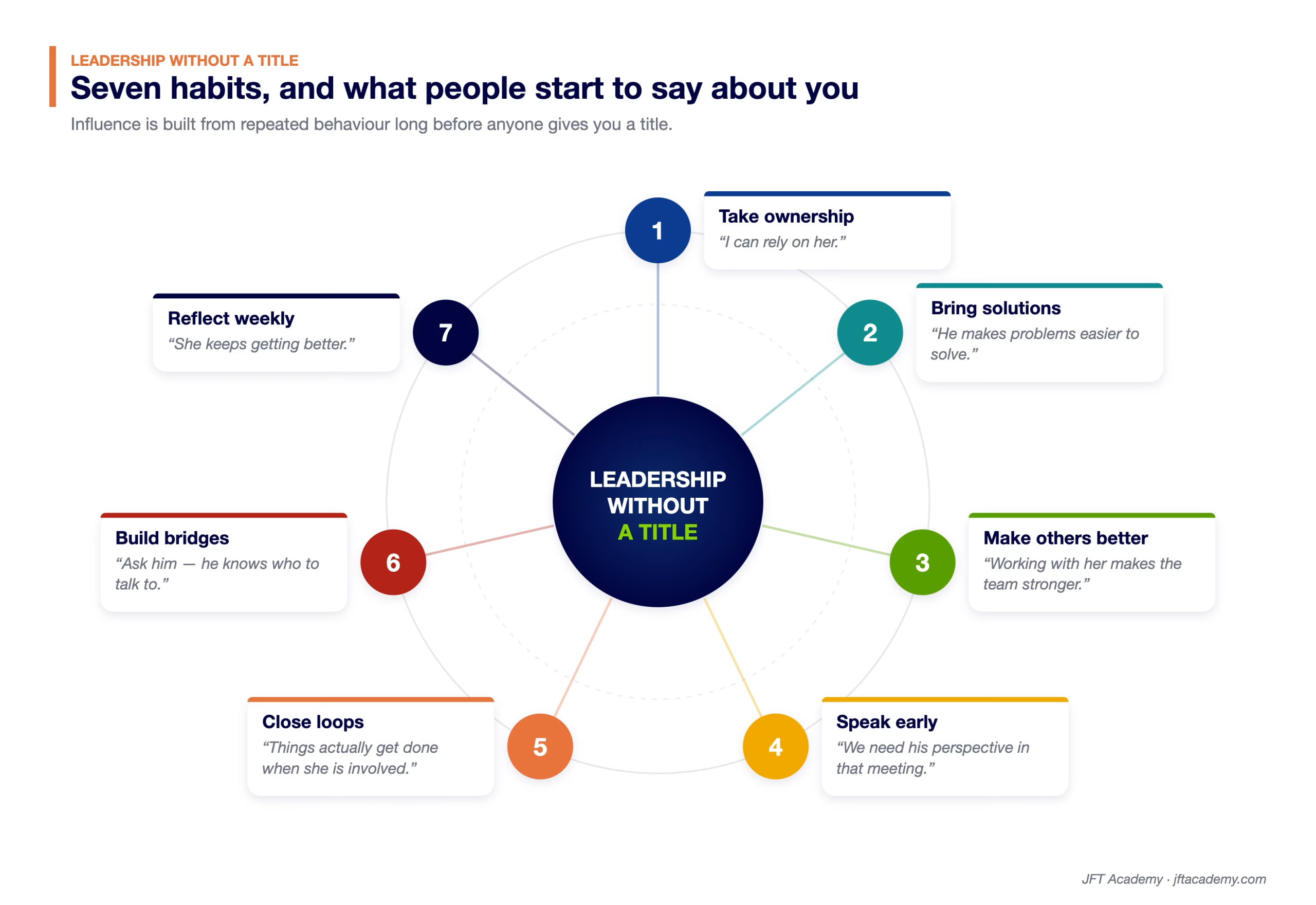
These reputations open doors: stretch assignments, project leadership, recommendations and, eventually, formal leadership roles.
A 30-day plan for leadership without a title
Habits stick when you practise them deliberately. Here is a simple 30-day plan to put leadership without a title into action:
- Week 1: Take full ownership of one task and close every loop on it — summary, data, thank-you.
- Week 2: Bring two solution options every time you raise a problem, and speak within the first ten minutes of each meeting.
- Week 3: Help one colleague succeed — share a method, review their work or introduce them to someone useful.
- Week 4: Connect two people or teams who should be working together, and spend 15 minutes reflecting on what you have learned.
After a month, review your notes. You will likely find that people respond to you differently. That is leadership without a title at work — and it is the foundation for every formal leadership role you take on in future.
Further reading: Harvard Business Review’s article You Don’t Need to Be “the Boss” to Be a Leader offers more ideas on building influence and practising leadership without a title.
Frequently asked questions
Can introverts lead without a title?
Absolutely. Most of these habits — ownership, closing loops, helping others and reflection — suit quieter people very well. Speaking early can be prepared in advance.
What if my organisation does not value these behaviours?
They still build your skills, network and reputation, which travel with you. Over time, they also make you more competitive for roles in organisations that do value them.
How long before people notice?
Small changes are often noticed within weeks. A strong reputation builds over months of consistency.
Go further
These seven habits are the starting point of my free self-guided programme Lead for Impact, which also covers systems thinking, decisions under uncertainty, influence without authority, feedback, resilience and building a theory of change for your own impact challenge. You may also enjoy Mentorship and Career Growth: Why Success Is Rarely a Solo Journey.
You do not need permission to lead. Start with one habit this week.